
A baseline review of a Cisco Industrial Ethernet switch at a water intake shows IP source routing is still enabled. Which hardening change fits?
Select an answer to reveal the explanation.
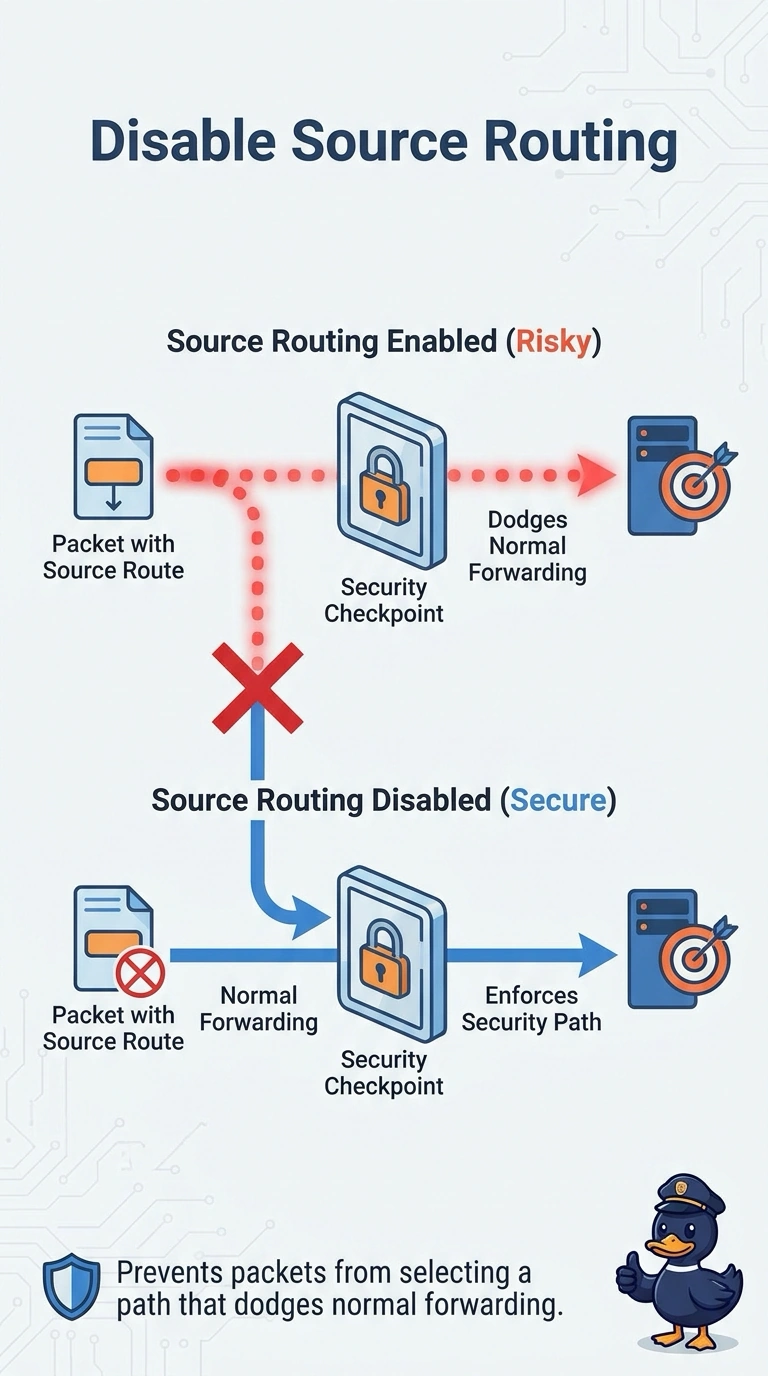
Short Explanation
Source routing lets a packet draw its own map instead of taking the roads you built. You turn that feature off on the intake switch so a crafted packet cannot steer around the normal path. A warning banner does not steer packets, and a web service on the switch is another open door.
Full Explanation
IP source routing lets a packet carry its own forwarding instructions. A crafted packet can try to take a path the normal routing table would not choose, which is a way around the forwarding and filtering design. On Cisco IOS the baseline hardening command is no ip source-route, which disables that behavior. The fitting change is to turn IP source routing off so a packet cannot select a path that dodges normal forwarding. Turning on the switch web server adds a management service on the intake VLAN. It does not disable source routing, and the usual baseline removes the HTTP server rather than opening it for a toggle. A login banner can warn a person. It does not change how the switch forwards packets, so source routing would still be enabled after the banner is painted on the login. Enabling source routing on every VLAN so maintenance probes can walk around access lists extends the feature the review is trying to remove and builds a bypass into the design. Exam caveat: if a documented diagnostic ever required source routing, that exception would be temporary and approved. A standing enable on an intake switch is not that exception. Operational check: the running configuration should contain no ip source-route, and the setting should be saved so a reload does not bring source routing back.