
A rail yard puts each interlocking in its own VLAN, then routes the VLANs on a Layer 3 switch with no policy between levels or toward the enterprise. Which design closes that gap?
Select an answer to reveal the explanation.
Short Explanation
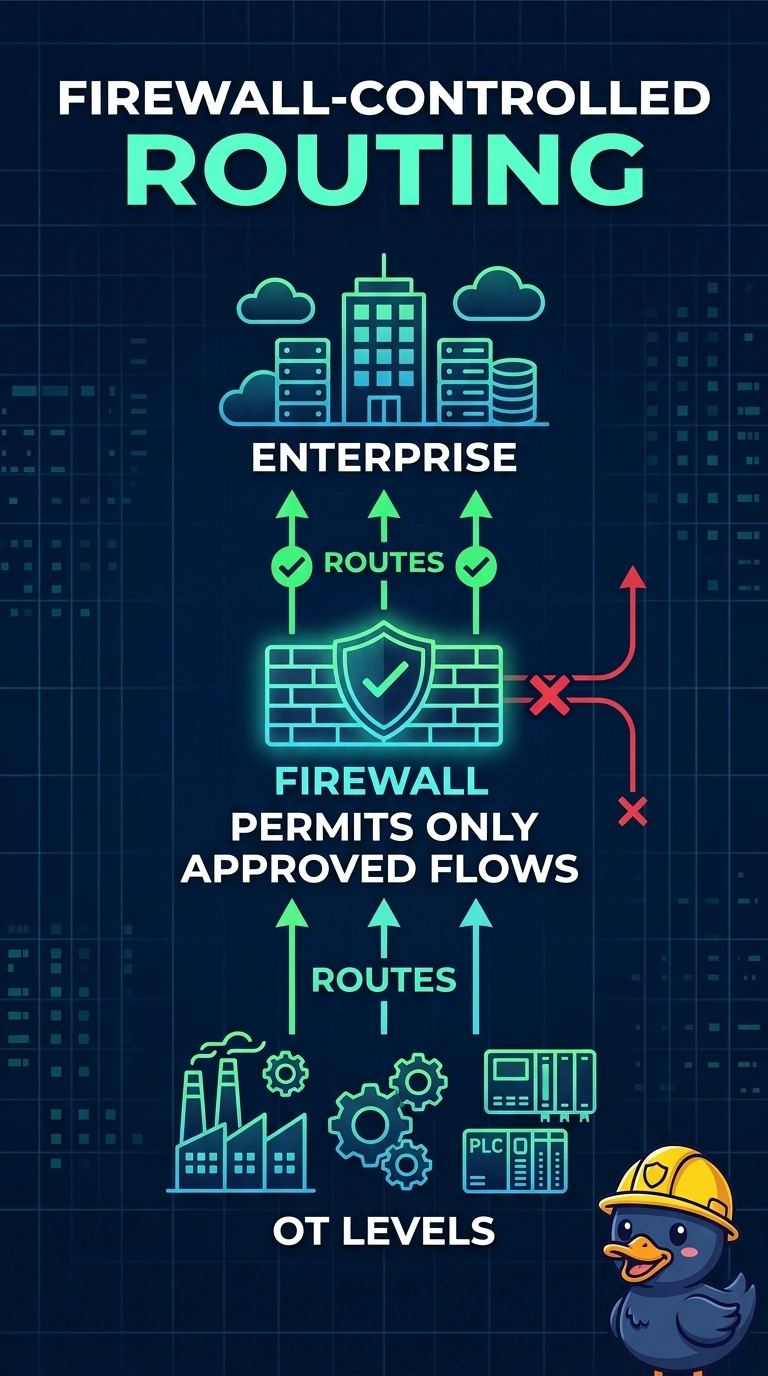
Painted lanes keep carts in their own bays, and they do not replace the guard at the street gate. You still send inter-level and enterprise routes through a firewall that names the flows you allow. Port security on a PC and a native VLAN change do not stand that guard.
Full Explanation
A VLAN gives each interlocking its own broadcast domain. The moment a Layer 3 switch routes those VLANs with no policy, a host that can route can reach across levels and toward the enterprise. Closing that gap means sending those inter-level and enterprise routes through a firewall that permits only the approved flows and denies the rest. The VLAN design stays. It stops being the only control. Keeping the open routing because VLANs 'already are the firewall' confuses a Layer 2 boundary with a policy point. Once routing exists, the VLAN does not inspect the conversation. Port security limits source MAC addresses on a switch port. Applied to enterprise PCs, it does not identify or permit an IP flow from the yard, and it does not sit on the routed path the stem left open. Moving the native VLAN onto the interlocking VLAN changes which traffic is untagged on a trunk. It does not add a permit list to the routes, so the open paths remain. Exam caveat: devices inside one interlocking VLAN still talk at Layer 2 without crossing the firewall. The firewall is the control for traffic that is routed between levels, not a substitute for segmentation inside the interlocking. Operational check: from an enterprise host with no approved rule, a connection to an interlocking PLC should fail, and an approved flow should succeed and show a hit on the firewall policy.