
A building-automation Cisco Industrial Ethernet switch still accepts SSH version 1 to its management address. Engineers already use SSH version 2 clients. Which change fits?
Select an answer to reveal the explanation.
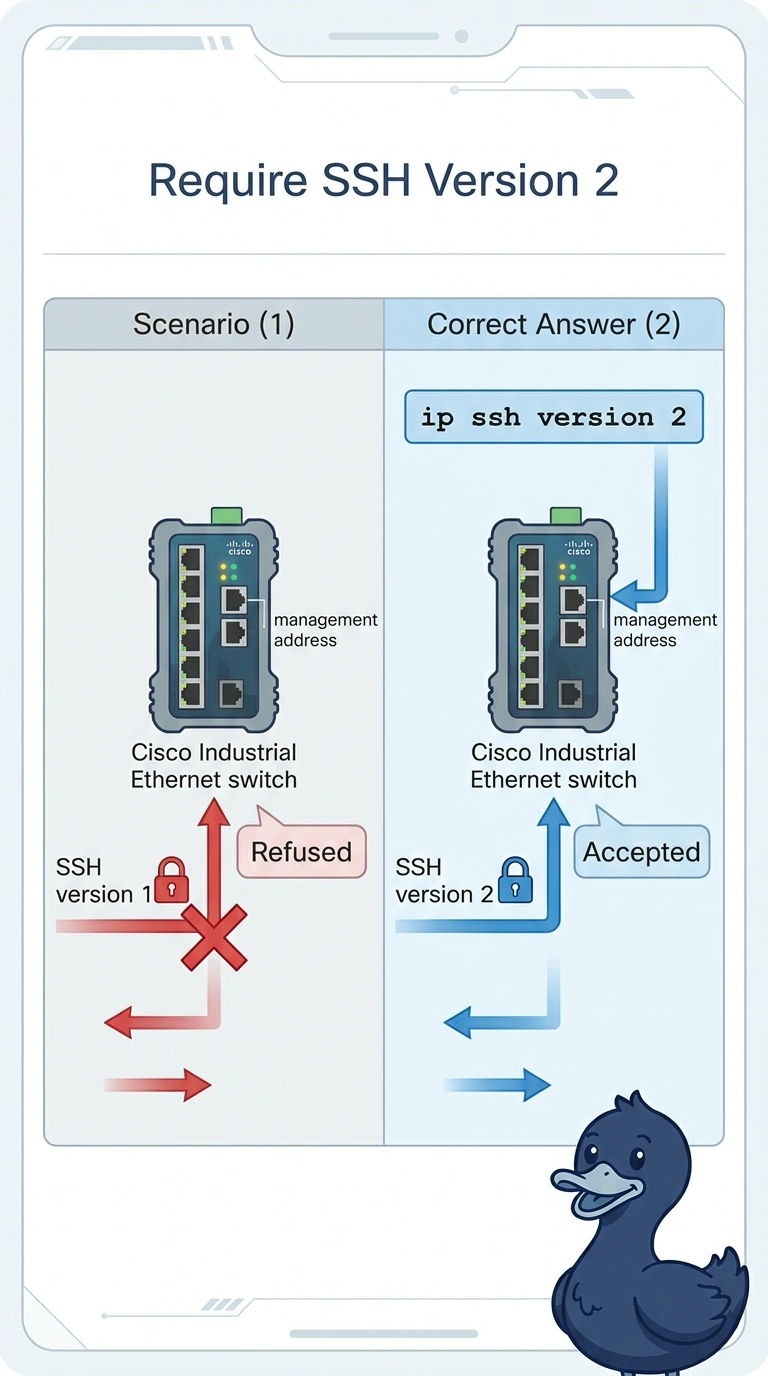
Short Explanation
SSH version 1 is an old lock that still opens. You tell the switch to accept only version 2, which is the client your engineers already use. A banner, a move onto VLAN 1, or a web page does not retire the old protocol.
Full Explanation
Cisco IOS selects the SSH protocol with ip ssh version. Setting it to 2 makes the switch accept only SSH version 2 and refuse version 1. That matches a site whose engineers already have version 2 clients and whose management address should not keep the older, weaker handshake. A login banner can ask someone to upgrade. The switch will still complete a version 1 session until the version command changes, so the banner does not enforce the baseline. Moving management onto VLAN 1 keeps version 1 and also places switch management in the controller VLAN, which fails the management-plane split. Enabling the web server adds HTTP, a cleartext management service the baseline turns off, and it does not disable SSH version 1. Exam caveat: SSH requires a supported host key and configuration; a named RSA key selected with ip ssh rsa keypair-name can enable SSHv2 without a configured domain name. This stem assumes SSH is already up and the remaining gap is version 1. Leave the version 2 clients on the management address, and do not add the web server as a stand-in. Operational check: from a version 1 client the connection should fail, and from an engineer version 2 client it should succeed to the management address only.