
A mill mirrors cell traffic to a monitoring laptop with a SPAN session and then treats that copy as the barrier that stops enterprise commands from reaching the PLCs. Which statement is accurate?
Select an answer to reveal the explanation.
Short Explanation
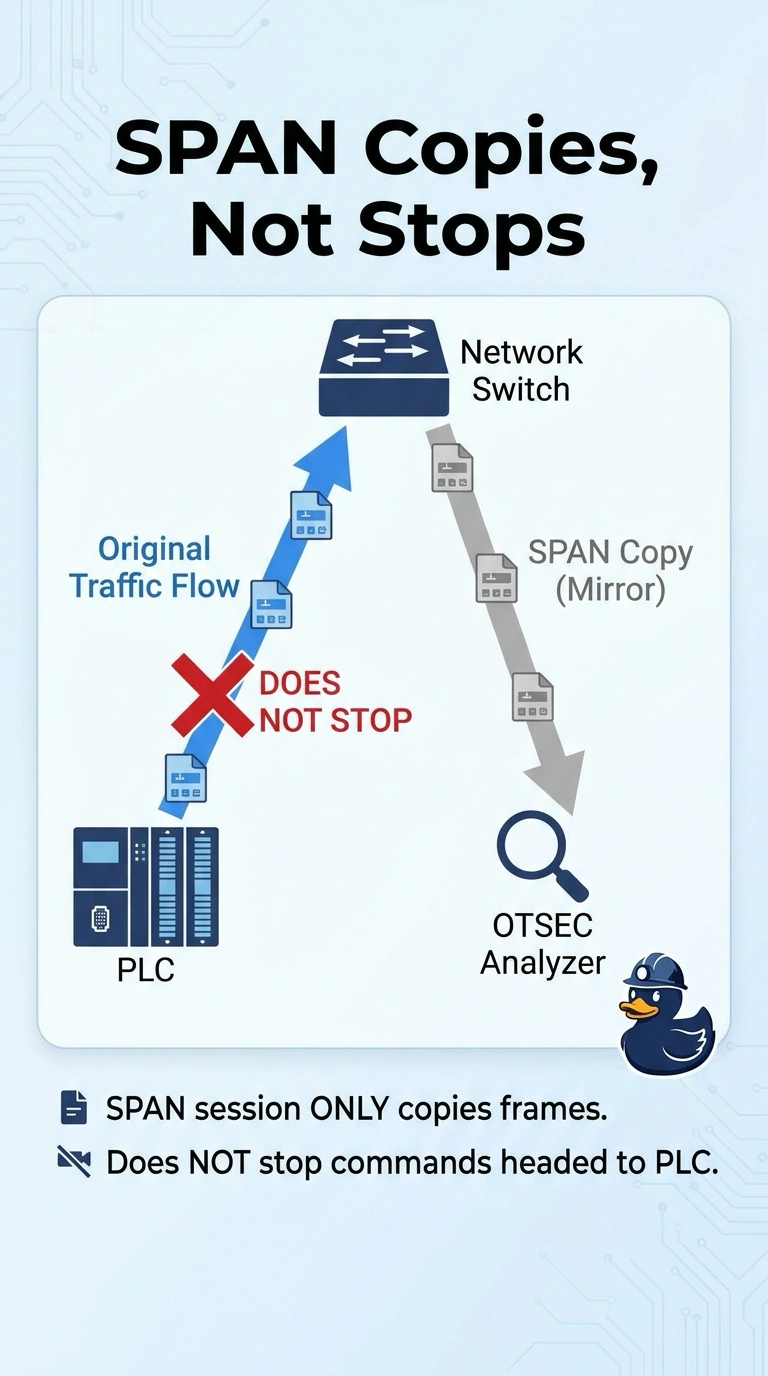
Think of a mirror port as a photocopier beside the hallway, not as a locked door. You get a copy of each frame, and the original still walks on to the PLC. The trap is treating that copy as if it could refuse a command.
Full Explanation
A SPAN or mirror session duplicates frames toward an analyzer. It does not sit in the forwarding path, so it cannot drop, rewrite, or reverse a command that the production port is already switching. That is why a monitoring laptop on the destination port can watch traffic and still leave the PLC fully reachable. Encryption is not what a SPAN session adds, and a copied frame is not a protected frame. Reversing direction is a property people expect from a one-way gateway, not from a mirror. A data diode is a separate hardware path that physically lacks a return; a mirror port does not become one because you aimed it at a laptop. The exam caveat is that a SPAN session is still the right feed for an inventory sensor. The operational check is to confirm the destination port is receiving copies while a permitted host can still open its normal session to the PLC. Put the before-and-after evidence in the work order, including the interface or account you changed, the time, and the person who approved it. On the next shift, confirm the original symptom is gone and that the change did not open a second path while closing the first. If the process is still inside a live batch, leave the controller running and finish only the part of this work that does not restart it. That sequence keeps a correct fix from turning into an unplanned outage.