
A bottling-line panel hides an unmanaged switch that connects a PLC, an HMI, and a drive to one Cisco Industrial Ethernet access port. A technician wants port security on that port with a maximum of one MAC address. Which outcome should stop that plan?
Select an answer to reveal the explanation.
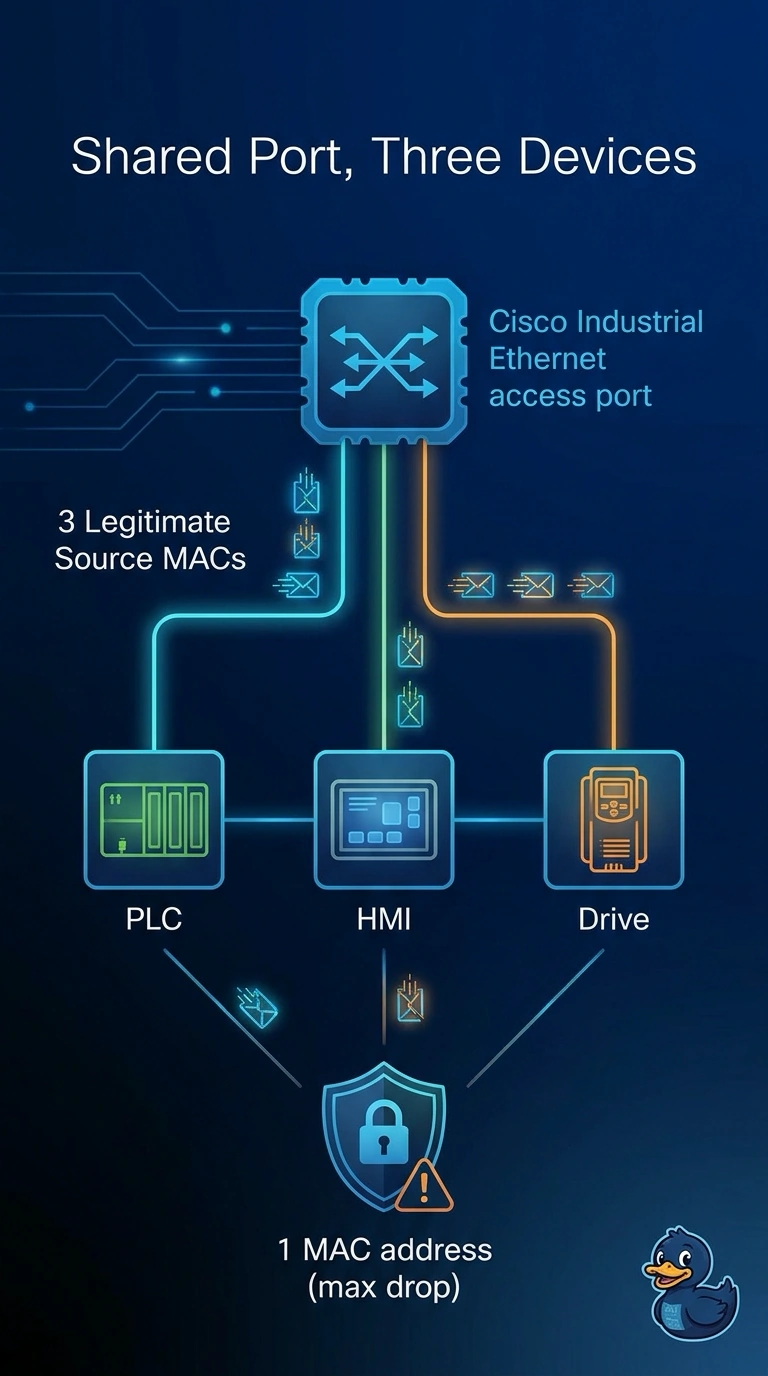
Short Explanation
That panel port is a hallway shared by three machines, not a reserved stall for one car. You cannot cap it at a single MAC without risking the whole panel when the second machine speaks. Encryption and a speed bump do not describe what a one-MAC limit will do there.
Full Explanation
An unmanaged switch bridges frames and leaves each end device's source MAC in place. The Cisco access port therefore sees the PLC, the HMI, and the drive as three source addresses, not as one address belonging to the small switch. Port security with a maximum of one accepts a single secure MAC and treats further source MACs as violations. In the default shutdown mode the port error-disables and the whole panel loses link. In restrict or protect mode the port stays up and frames from the extra MACs are dropped, so two of the three machines still fail. Either outcome breaks a panel that needs all three devices, which is why the plan should stop. The idea that the unmanaged switch counts as one MAC would fit a router or a proxy that rewrites sources. A plain bridge does not do that. Port security does not encrypt traffic and it does not install a passphrase. It only limits which source MACs may send. Changing the maximum does not change the port's speed. Speed and duplex are a different configuration from the secure MAC count. Exam caveat: a panel device that truly proxies every machine behind one source MAC would present a different count. This stem is an unmanaged switch, which forwards the three addresses. Operational check: show the MAC address table for that port and expect the PLC, the HMI, and the drive, and do not leave a maximum of one on a port that must carry all three.