
A wastewater plant's network monitor still polls cell switches with the SNMP community string public, and that string is printed on a shared diagram. Which management change fits?
Select an answer to reveal the explanation.
Short Explanation
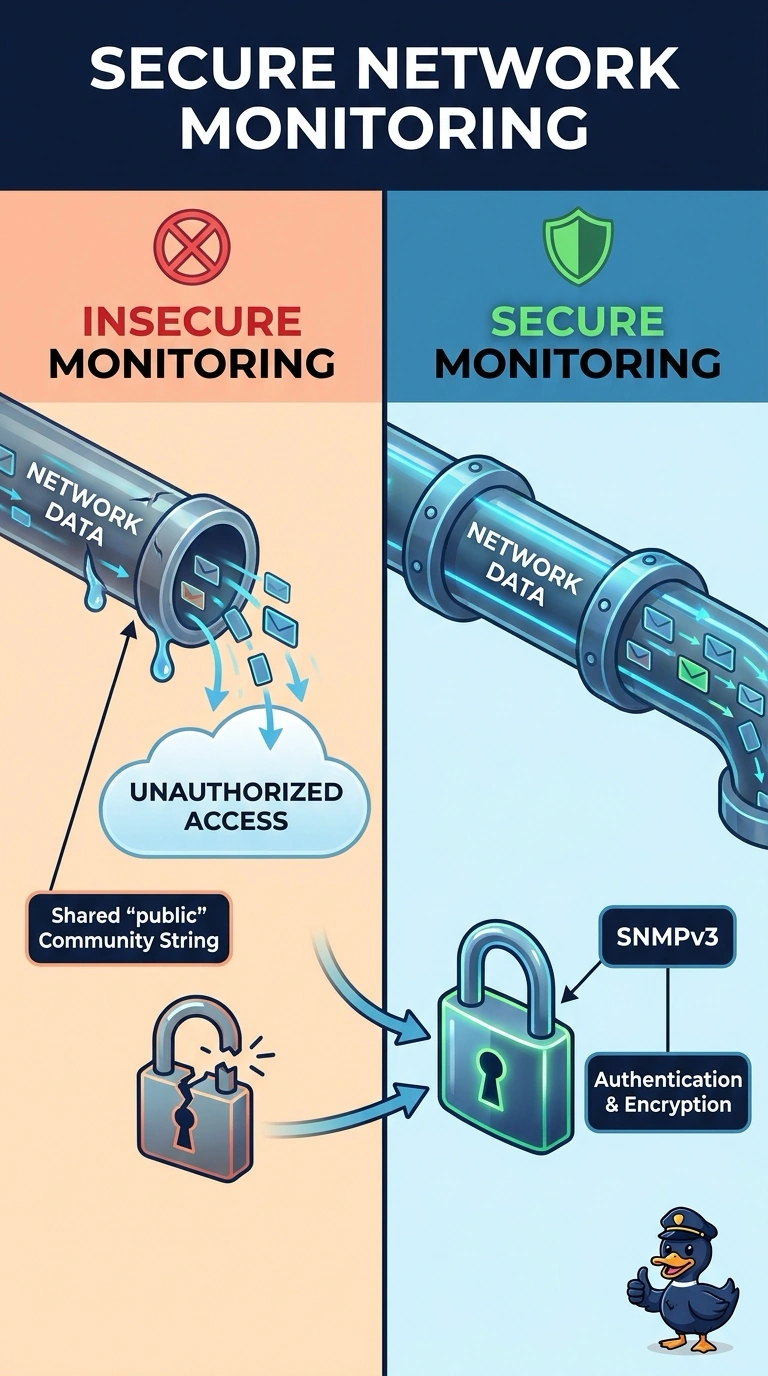
You can keep monitoring the switches while replacing the exposed shared secret with SNMPv3, which authenticates the poller and encrypts the poll. Moving public to another UDP port or printing it in a banner still exposes the same credential, while posting read-write communities makes access riskier. You’re tightening management access by retiring public, not just hiding or redistributing it.
Full Explanation
SNMP communities in versions 1 and 2c are shared secrets sent with the poll, and public is a widely known community value; the switch must also be configured to accept that community. Because the diagram exposes it, anyone who can reach the management address may be able to read the switch, and a read-write community can let them change it. The monitor still needs to poll, so use SNMPv3 with authentication and encryption, then retire public. The monitor uses a named user, its poll is authenticated, and its payload is encrypted. Moving public to another UDP port only hides the service from scans that guess the usual port; the shared secret remains exposed on the diagram. Adding several read-write communities and printing them on the cabinet door multiplies writable secrets and publishes them, undermining access control. Keeping public and printing it in the banner discloses the credential while retaining a cleartext community protocol. Exam caveat: SNMPv3 can be configured without encryption, so authentication alone is weaker than authentication plus privacy; choose both and remove public. Practical check: polling with public should fail, while the network monitor should succeed using its SNMPv3 user from the management station only.