
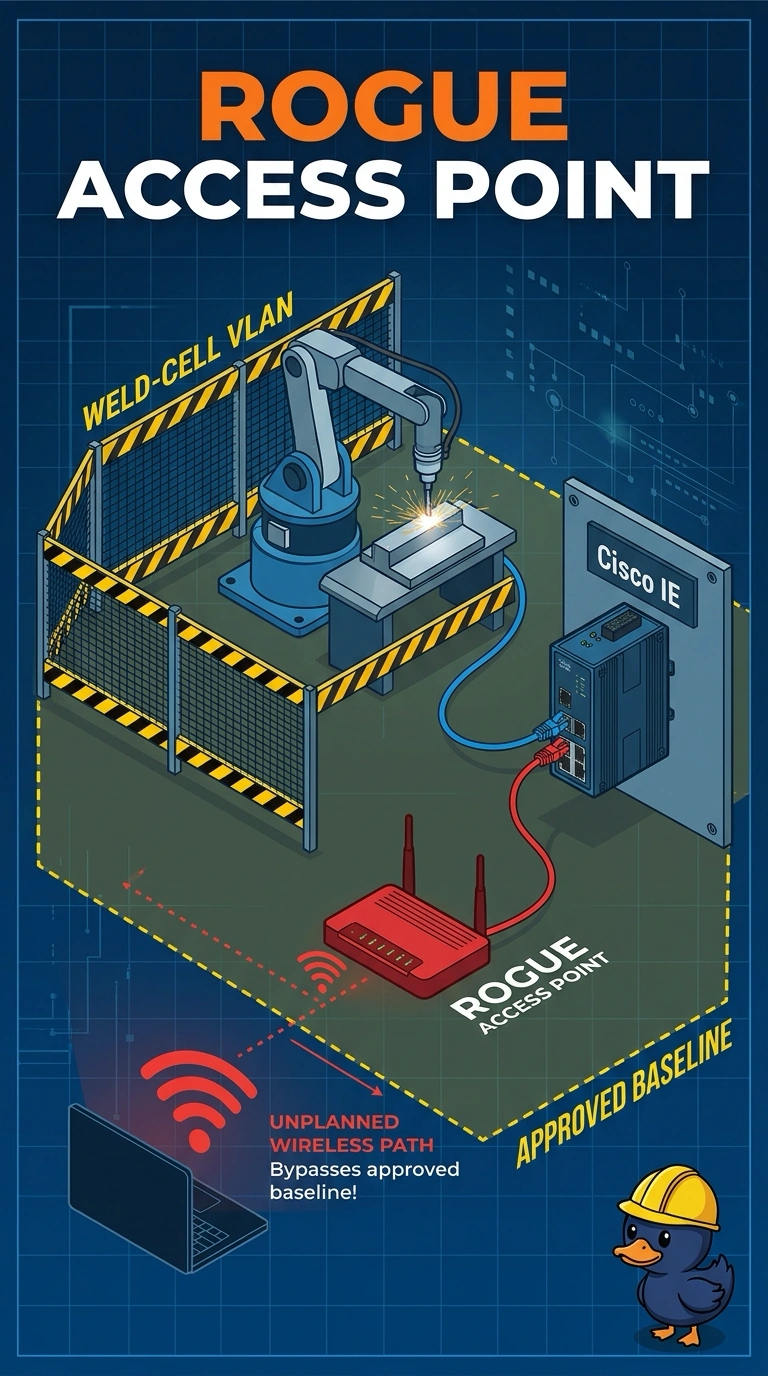
At an auto-body plant, an unknown wireless access point is plugged into a Cisco IE access port on the weld-cell VLAN. Which issue should the crew treat that as?
Select an answer to reveal the explanation.
Short Explanation
An unknown access point in a weld-cell jack is a window cut into the wall after the drawings were signed. You treat it as a rogue wireless entry onto that VLAN, not as a survey item the plant simply forgot to file. Contractor convenience does not make an unidentified radio part of the cell.
Full Explanation
An access point plugged into a cell access port bridges wireless clients into that VLAN. The device is unknown, it sits on the weld-cell VLAN, and no baseline named it. The crew treats it as a rogue access point: an unapproved wireless entry into the cell. WirelessHART is a radio for field instruments, not a label for every unknown access point someone cabled into Ethernet. Weld-tip sensors on a designed instrument mesh would be a known system, and this stem is an unidentified access point on a switch port. A site survey can justify a planned radio in a planned VLAN. It does not turn an unknown device, discovered already plugged in, into the intended fix. An approved guest network is a known SSID with a known landing VLAN, and a guest network does not belong on the weld-cell VLAN in any case. Calling this port a guest design invents an approval the stem does not have. Exam caveat: a later project can add plant wireless under a change, on a VLAN chosen for that purpose. Until that change exists, this access point is rogue. Operational check: trace the switch port, shut it or remove the device if nobody owns an approved change, and confirm wireless clients no longer appear on the weld-cell VLAN.