
An oil-platform Cisco router still honors IP packets that select their own forwarding path across the platform. Which hardening step matches the baseline?
Select an answer to reveal the explanation.
Short Explanation
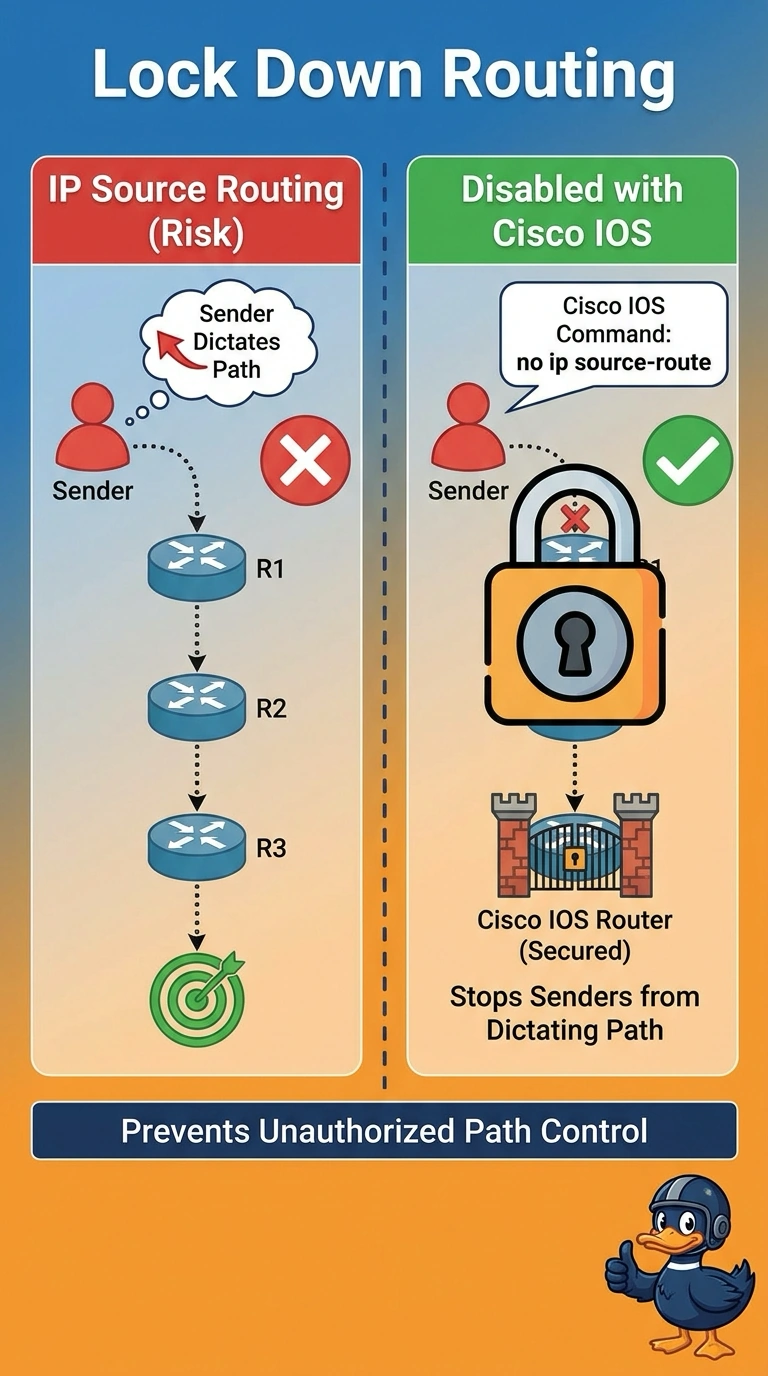
Source routing lets each packet sketch its own map across the platform instead of using the map the router was given. You turn that behavior off with no ip source-route so a sender cannot steer the path. A warning on the login screen does not stop the packet from choosing.
Full Explanation
IP source routing lets the sender specify the path a packet takes, which is a way around the forwarding decisions the platform routers were built to enforce. The Cisco IOS hardening step that stops the router from honoring those packets is the global command no ip source-route. With it in place, senders no longer dictate the path across the platform, and ordinary forwarding continues from the routing table. Enabling source routing so a technician can steer around a failed link hands that bypass to every sender, not only to the technician, and it reverses the baseline. A login banner can state policy to a person who opens a session. It does not filter packets, so source-routed traffic keeps flowing while the banner waits for a login. Transport input ssh on the VTY lines restricts the remote shell to SSH. That is a real management control, and it does not affect whether forwarded packets may choose their own route. Leaving source routing honored means the reported behavior stays. Exam caveat: this command stops the router from accepting source-routed packets. It is not a change of routing protocol, and normal forwarded traffic is still routed. Operational check: confirm the running configuration contains no ip source-route, then verify a source-routed test packet is not forwarded while an ordinary packet between the same platform subnets still is.