
On a fertilizer plant, the trunk between two Cisco IE cell switches uses the PLC control VLAN as its untagged native VLAN. Which change matches a secure segmentation baseline?
Select an answer to reveal the explanation.
Short Explanation
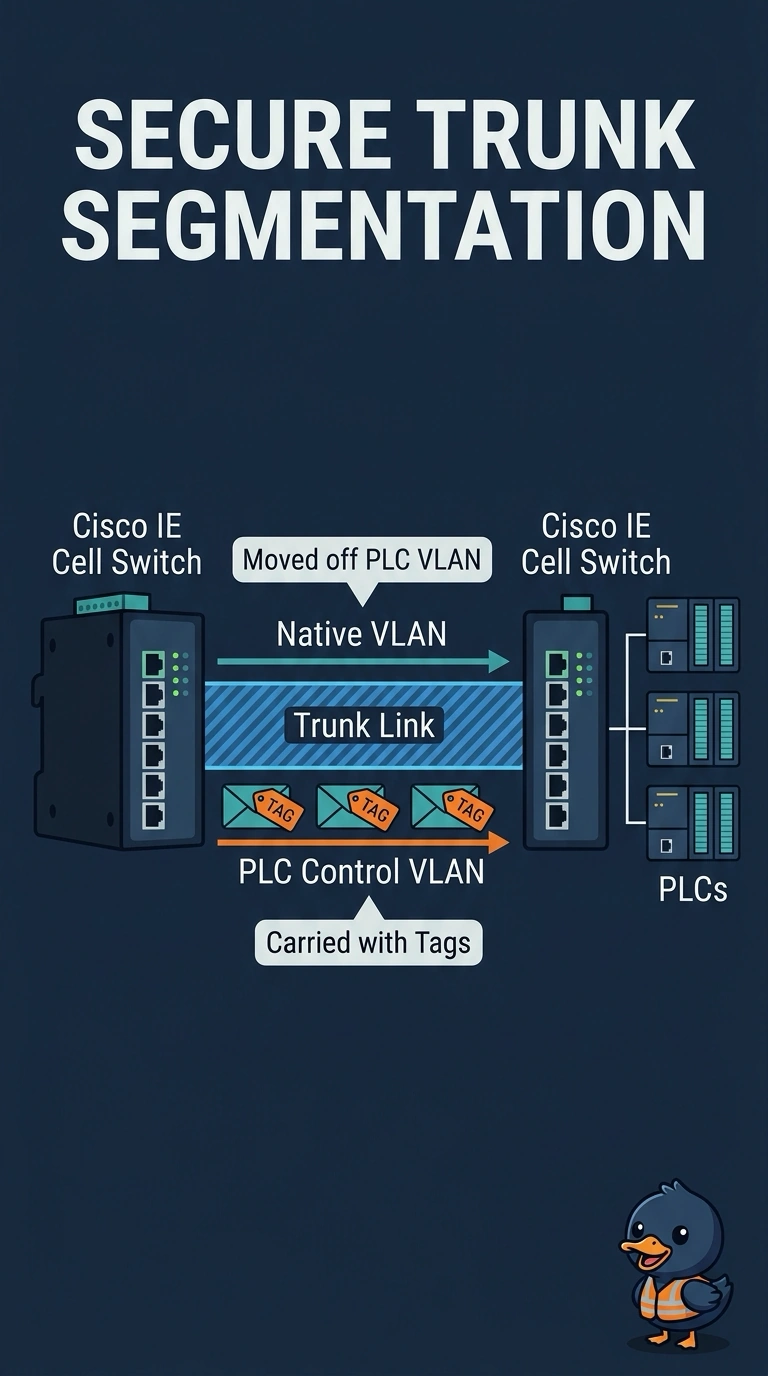
An untagged native VLAN that is also the control VLAN is an unmarked side door into the fertilizer network. You move the native VLAN off the PLC VLAN and you tag the control traffic on the trunk. Leaving the control VLAN untagged for easy troubleshooting keeps that side door in service.
Full Explanation
On an 802.1Q trunk the native VLAN is the VLAN that crosses untagged by default, unless native tagging is configured. If that native VLAN is the PLC control VLAN, untagged frames on the trunk land in the control broadcast domain. A secure baseline moves the native VLAN to an unused VLAN and carries the PLC control traffic with tags, so untagged frames are not control traffic. Leaving the control VLAN untagged to make captures easier keeps the control network on the untagged path. Convenience of a sniffer is not a reason to leave that mapping. Supported Cisco IE platforms allow port security on static access and trunk ports; it does not change native-VLAN classification. It does not redefine which VLAN is native. Relying on it leaves the untagged control VLAN in place. Moving the native VLAN to the enterprise resource-planning VLAN does not remove the need for a control VLAN, and it would aim the untagged trunk path at the business systems instead. The control VLAN should stay, tagged, and the native VLAN should be one the plant does not use for PLCs or for ERP. Exam caveat: this change is about which VLAN is untagged on this trunk. It does not decide every other VLAN allowed inside the cell. Operational check: on both ends of the trunk, the native VLAN should match and should not be the PLC control VLAN, and control frames on a capture of the trunk should be tagged.