
A pharma packager enabled sticky port security on a blister-line PLC port, saw the PLC MAC go secure, then reloaded the Cisco IE switch without saving. The secure MAC was gone afterward. Which explanation fits?
Select an answer to reveal the explanation.
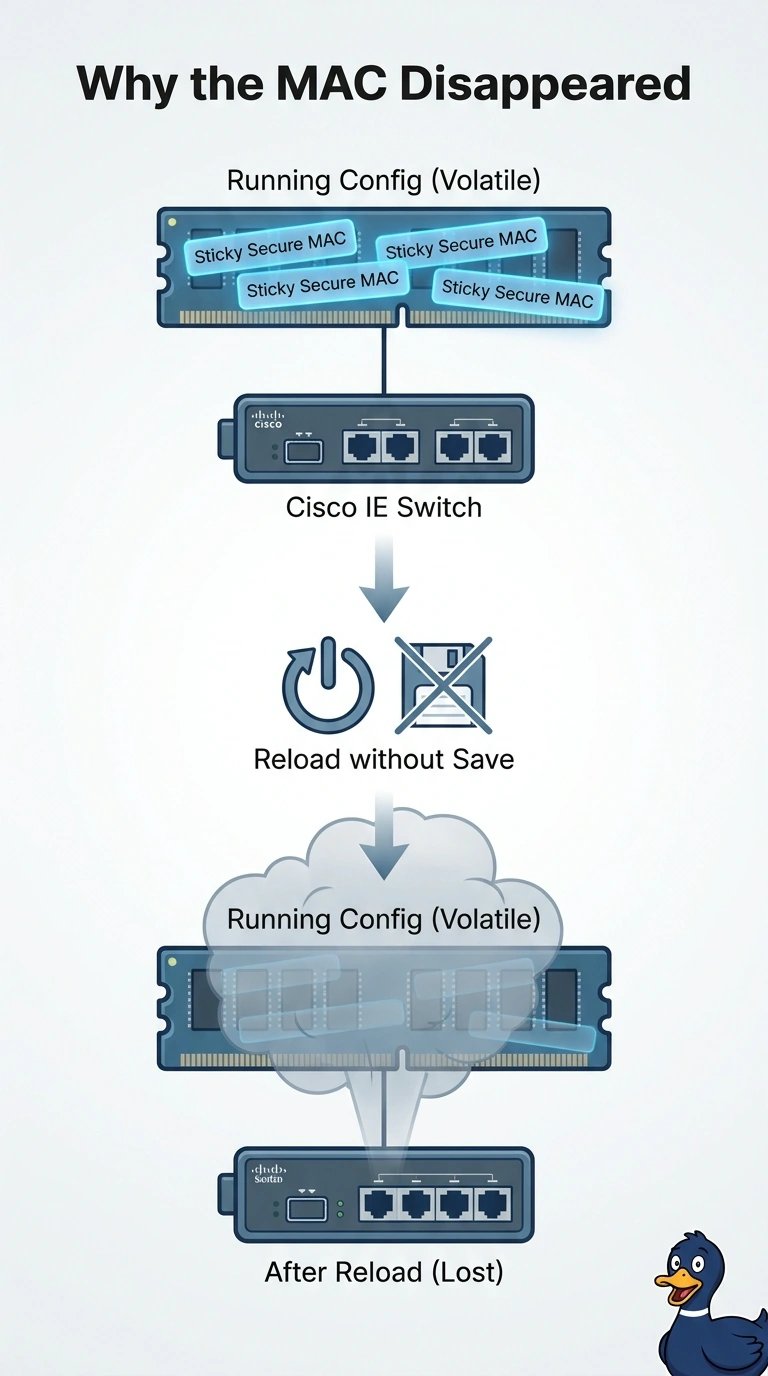
Short Explanation
Sticky port security is a note on a whiteboard, not ink in the binder that survives a power cut. You learned the PLC address in the running configuration, and a reload without a save threw that note away. The startup copy is what comes back, and this address was never written there.
Full Explanation
On Cisco IOS, sticky port security writes a learned secure MAC into the running configuration. That line is not in the startup configuration until someone saves. The packager reloaded without saving, so the switch booted a startup file that had never received the PLC address, and the secure MAC was gone. The port can learn it again, which matches a feature that was only in memory. Sticky learning does not write startup configuration by itself. Skipping the save is exactly why the address failed to survive, so the claim that a save is unnecessary reverses the mechanism. DHCP lease renewal is unrelated. A sticky entry is a MAC binding, not an address lease, and a reload does not require the PLC to renew DHCP before the secure MAC can persist. Violation mode protect drops frames from an unexpected MAC and leaves the port up. It is not the event that erased a saved address, and this stem has no second MAC. The loss follows the unsaved reload. Exam caveat: after a save, the sticky MAC is in the startup file and a later reload keeps it. This stem is the unsaved case. Operational check: before the next reload, confirm the PLC MAC appears under the interface in the running configuration and in the startup configuration after the copy.