
Cement-plant technicians want tablets on wireless for rounds. Someone suggests bridging that SSID straight into the controller VLAN and printing the shared key on the cabinet. Which design is sound?
Select an answer to reveal the explanation.
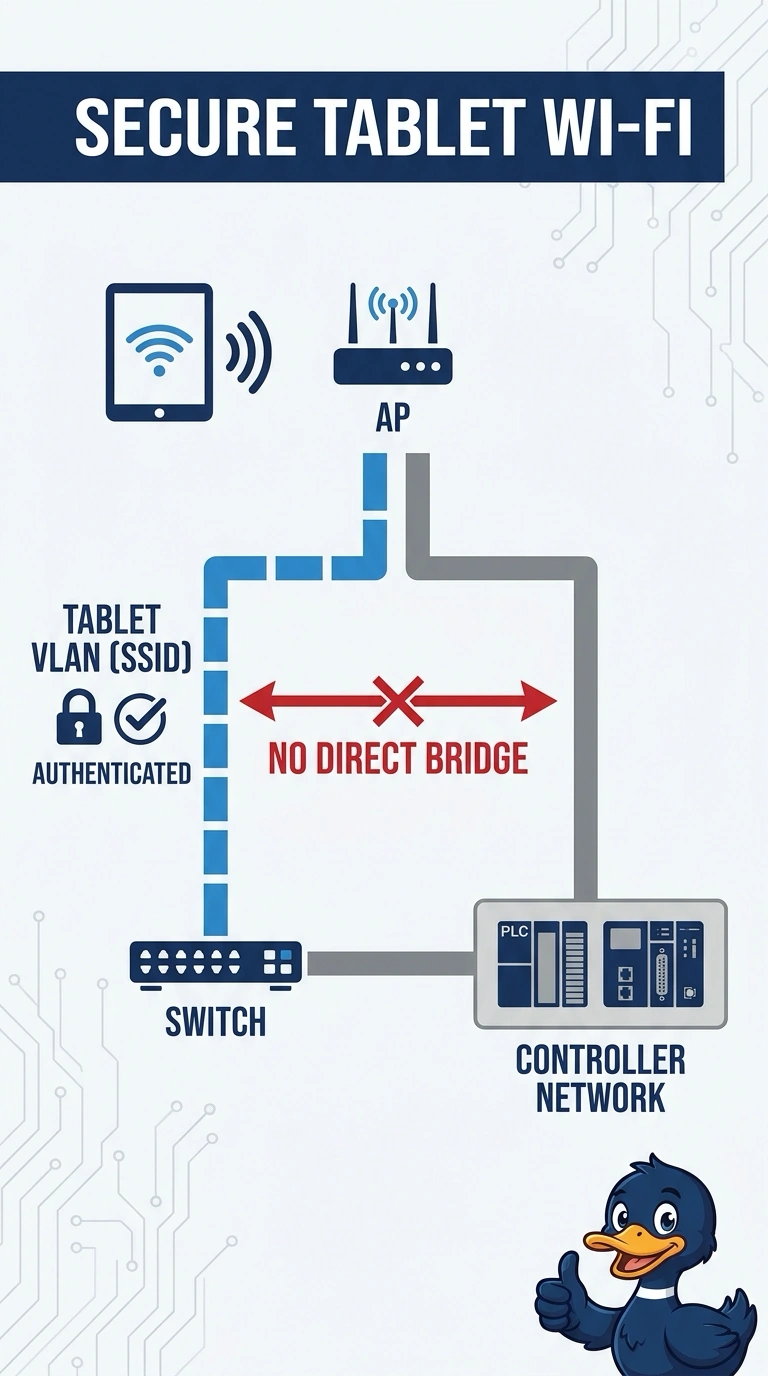
Short Explanation
A tablet on rounds is a visitor's radio, not a controller. You give it a separate VLAN and a real login, and you do not nail the wireless password to the cabinet that guards the PLCs. Private property does not stop a radio at the fence.
Full Explanation
Wireless in OT adds a shared medium and a new way onto the network. Technician tablets do not need to sit in the controller VLAN. The sound design puts their SSID on its own VLAN, authenticates the clients, and forces any reach into the controllers through an explicit, limited path rather than a bridge. Bridging the SSID into the controller VLAN makes every associated radio a host beside the PLCs. An open SSID trusts the fence. Radio does not stop at the property line, and an open network does not identify the tablet. Printing a shared key on the cabinet discloses the secret to anyone who can see the door and, combined with a bridge, invites that person into the controller VLAN. A pre-shared key shared by every contractor is already a weak pattern. Posting it is worse. Exam caveat: if a tablet must read a specific HMI, permit that flow from the wireless VLAN through a firewall rule. Do not solve it by merging VLANs. Safety trips still do not move onto this SSID. Operational check: from an authenticated tablet, a controller programming port should fail, the approved HMI view should succeed only if it was permitted, and the key should not be recoverable from a cabinet label.