
On a sawmill Cisco IE switch, every technician logs in with one privilege 15 account. Operators only need to view status, and engineers change configuration. Which credential baseline fits?
Select an answer to reveal the explanation.
Short Explanation
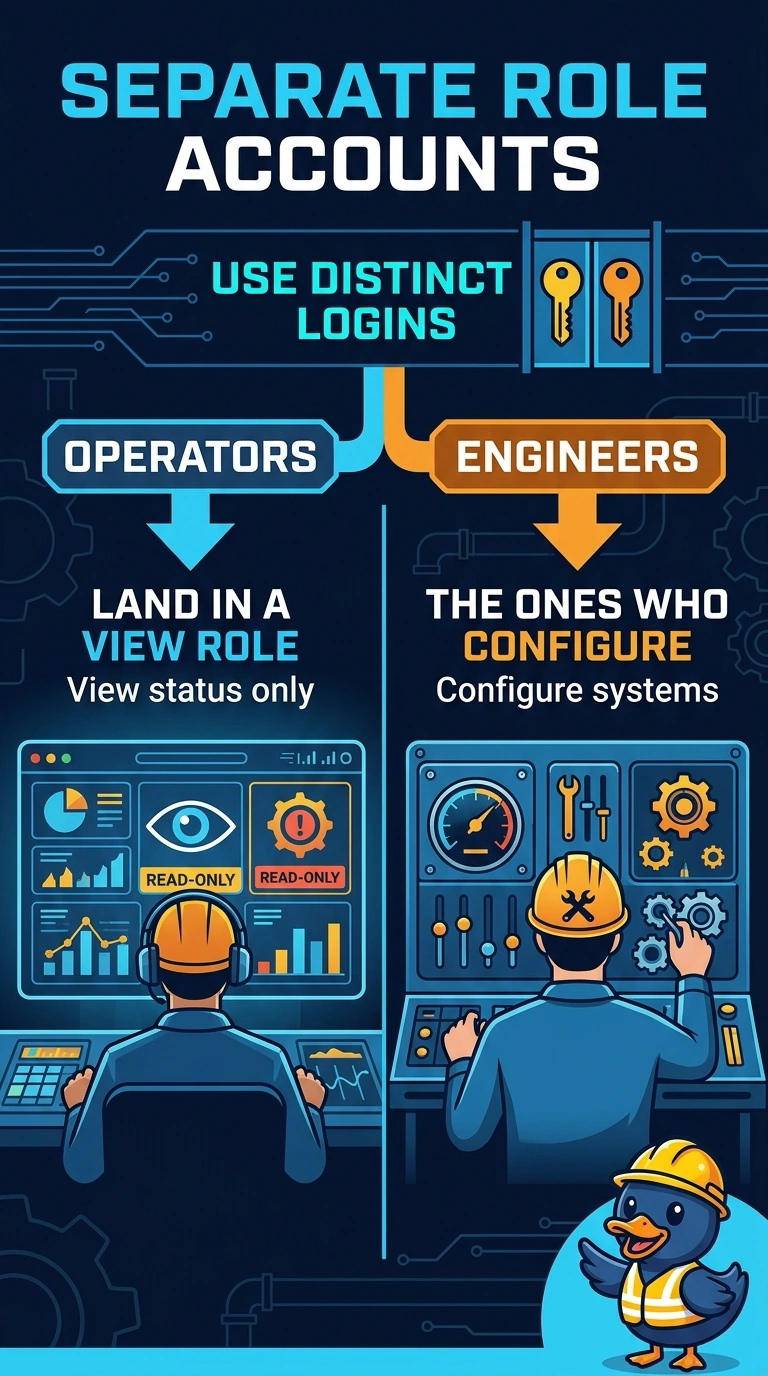
You give operators a view role and keep configuration access with separate engineer accounts, so a status check cannot change the switch. A shared privilege 15 login or enable secret does not separate those jobs, and the SNMP community public does not assign them different rights.
Full Explanation
Role-based credentials mean the commands you can use follow your job. On IOS, a privilege 15 account has full administrative access. Operators who only view status should use an account that can run show commands but cannot enter configuration; engineers should use separate accounts with configuration access. The separate-account approach fits the need because it limits each role and helps identify who made a change. Keeping one shared privilege 15 account so nobody has to choose a role during an outage preserves full access for every technician and hides which person typed a command. Removing usernames and sharing one enable secret creates a shared door code, not an operator role, and does not attribute the session. Using the SNMP community public also fails: it is a widely known string, not a role system, and SNMPv1 or v2c communities are a poor substitute for SSH accounts. Exam caveat: local privilege levels can be enough for a small mill, while a larger site usually manages roles through AAA and keeps a local fallback that is not privilege 15 for everyone. Practical check: log in with the operator account and confirm configuration mode is denied, then log in with the engineer account and Enable appropriate AAA command accounting or configuration-change logging, then verify changes are attributable to the named engineer; separate usernames alone do not enable accounting.