
A container-port Cisco Industrial Ethernet switch still answers SNMP polls sent to the community string public. Which change belongs in the hardening baseline?
Select an answer to reveal the explanation.
Short Explanation
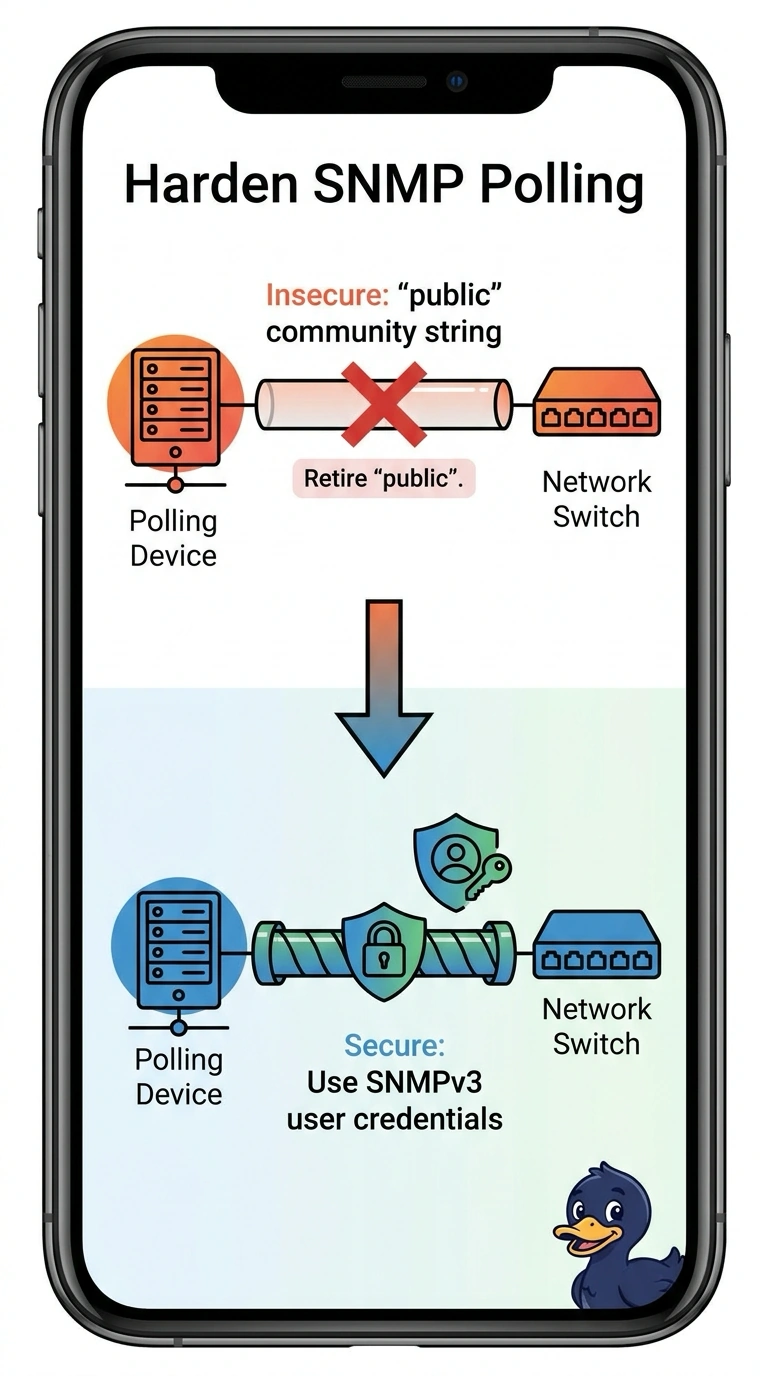
A community string of public is a padlock that still uses the code it shipped with. You can hang a warning on the cabinet and anyone who can reach the switch will still try that code. Retire it and poll with SNMPv3 users that belong to your team.
Full Explanation
Widely known SNMP community values are shared secrets that have lived in manuals for years, and public is the string strangers already try. A Cisco Industrial Ethernet switch that still answers polls to public will give its management data to any host that can reach the SNMP service and present that string. The baseline retires the community and moves monitoring to SNMPv3, where each polling system has its own user and the exchange can be authenticated. Use SNMPv3 authentication and privacy, restricted to authorized management systems; merely selecting version 3 does not enable either protection. A login banner does not change which community the agent accepts. It is a notice for a person at the prompt, and the switch keeps answering public. Enabling the HTTP server adds a management listener the hardening baseline turns off, and it does not retire the community. Posting public on the cabinet door spreads the same default and leaves the service unchanged. Exam caveat: authenticated polling from the station that watches these switches is still appropriate. The decision is to drop the published community, not to ban network management. Operational check: from a host on the controller VLAN, a poll that uses public should fail, and an SNMPv3 poll from the monitoring station with its own user should succeed.