
A technician applied an extended ACL on a packaging-cell switched virtual interface to stop a panel PC from reaching a PLC. Both are in that same VLAN, and the PC still connects. Why?
Select an answer to reveal the explanation.
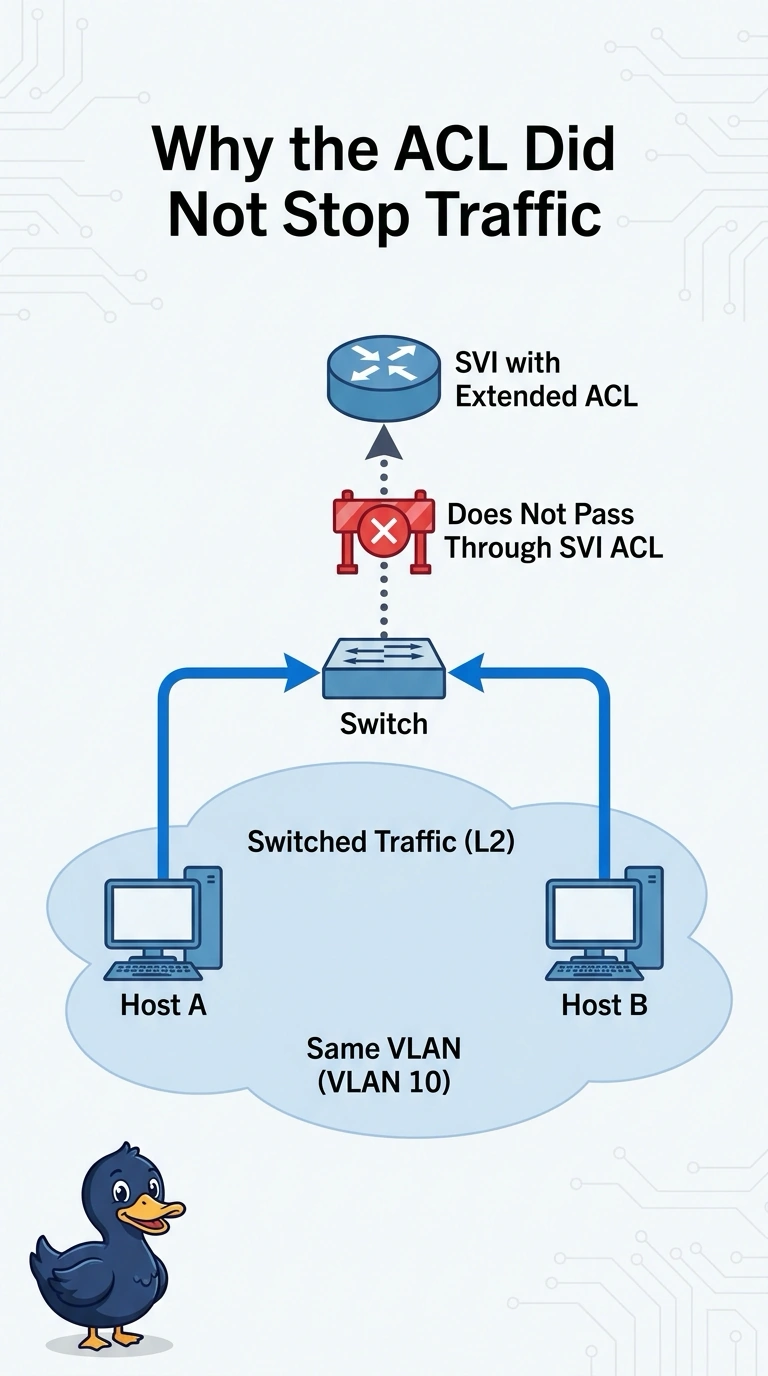
Short Explanation
You put the guard at the stairwell, but these two hosts share a room: same-VLAN traffic is switched at Layer 2 and never passes the routed interface where your ACL sits. You need a control that can see traffic inside the VLAN, or you can move the untrusted PC to another VLAN so its traffic is routed and the ACL can match.
Full Explanation
On a multilayer switch, an ACL on a switched virtual interface filters traffic routed through that interface. Frames between the panel PC and PLC in the same VLAN are forwarded by the switching hardware, not routed, so they never encounter the SVI ACL and the PC still connects. A PLC does not ignore extended ACLs in favor of standard ACLs; the switch ACL is not reached in this topology. Port security limits source MAC addresses on a port. It is not a mechanism that prevents an IP ACL from being evaluated, so it does not explain why this connection succeeds. An ACL on an enterprise firewall’s guest wireless zone is a different boundary and does not inspect a packaging-cell conversation that never leaves the cell VLAN. The useful fix is to place the untrusted PC in a different VLAN so the path is routed and the ACL can match. Exam caveat: if the PC were in another VLAN, the same ACL could be the right tool; you would then check its direction and the protocol ports. The same-VLAN placement is what makes this ACL the wrong place. Practical check: show vlan brief should show both ports in one VLAN, and a test host moved to a routed VLAN should hit the ACL counters in show ip access-lists.