
A grain elevator proposes moving an emergency-stop trip between two safety controllers off a dedicated wire and onto the office wireless LAN. Which implication should stop that design?
Select an answer to reveal the explanation.
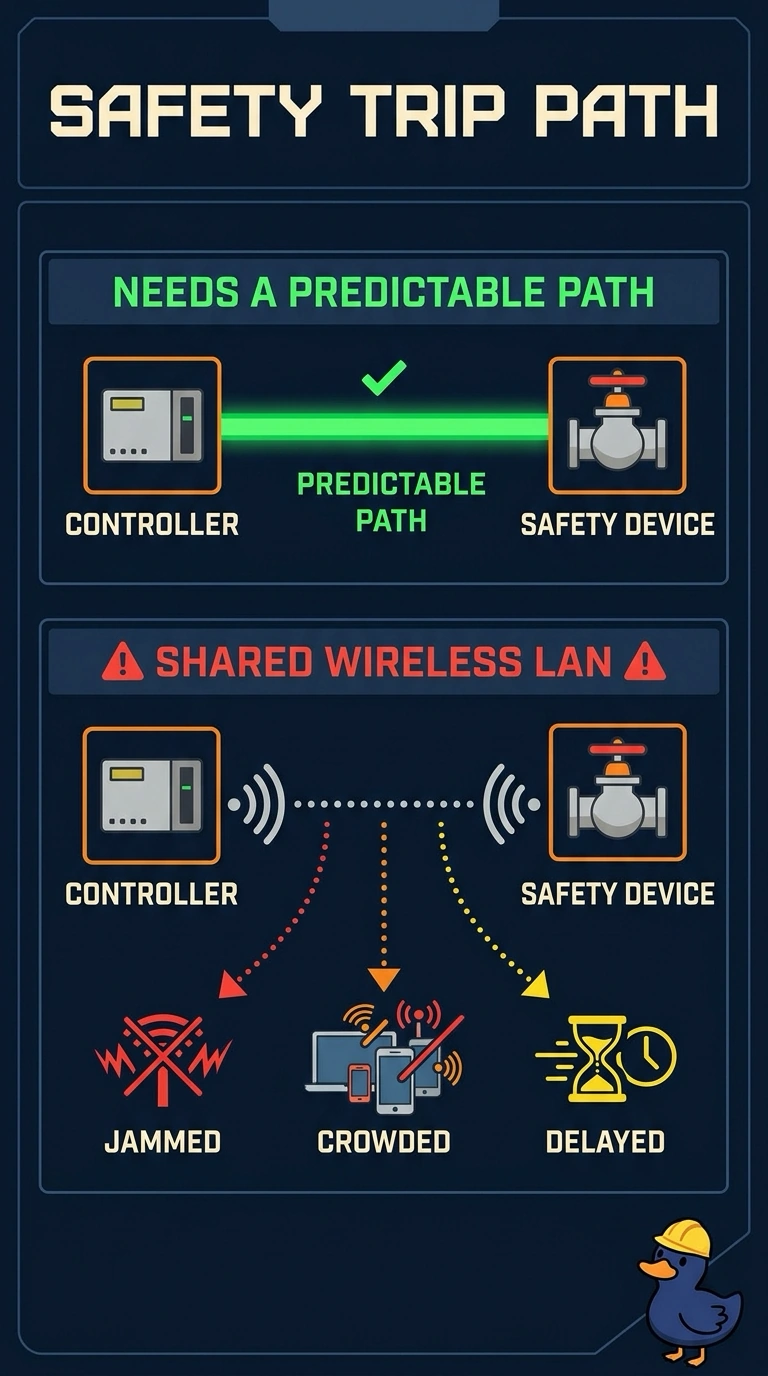
Short Explanation
You need an emergency-stop trip to follow a predictable path, not compete with office traffic or interference. Keep it on a dedicated safety medium; a password on the cabinet cannot make shared wireless deterministic.
Full Explanation
An emergency-stop trip between safety controllers needs a predictable path so the stop signal is not delayed or lost. Moving it onto the office wireless LAN exposes it to crowding, interference, and jamming, so the design cannot rely on timely delivery. The claim that an industrial SSID removes delay because collisions cannot occur overstates what wireless provides: wireless uses shared spectrum, and the office LAN is not dedicated to the trip. Requiring a message broker is also wrong. A queue can add delay, which is the wrong behavior for a trip that must stop equipment promptly, and a safety trip is not required to use a broker. Printing the wireless password on the controller cabinet does not make the radio path predictable or resistant to jamming; it also exposes access credentials. Exam caveat: purpose-built industrial wireless may be used for non-safety instrumentation after appropriate planning and segregation, but that is different from placing a safety trip on the office SSID. Practical check: confirm the safety network drawing keeps the trip on its dedicated wire or safety bus, with no route from the office SSID into the safety controllers.