
A pharmaceutical packaging cell's Cisco IE switch still answers on the web interface and on Telnet. SSH is already working for the engineers. Which hardening step fits the baseline?
Select an answer to reveal the explanation.
Short Explanation
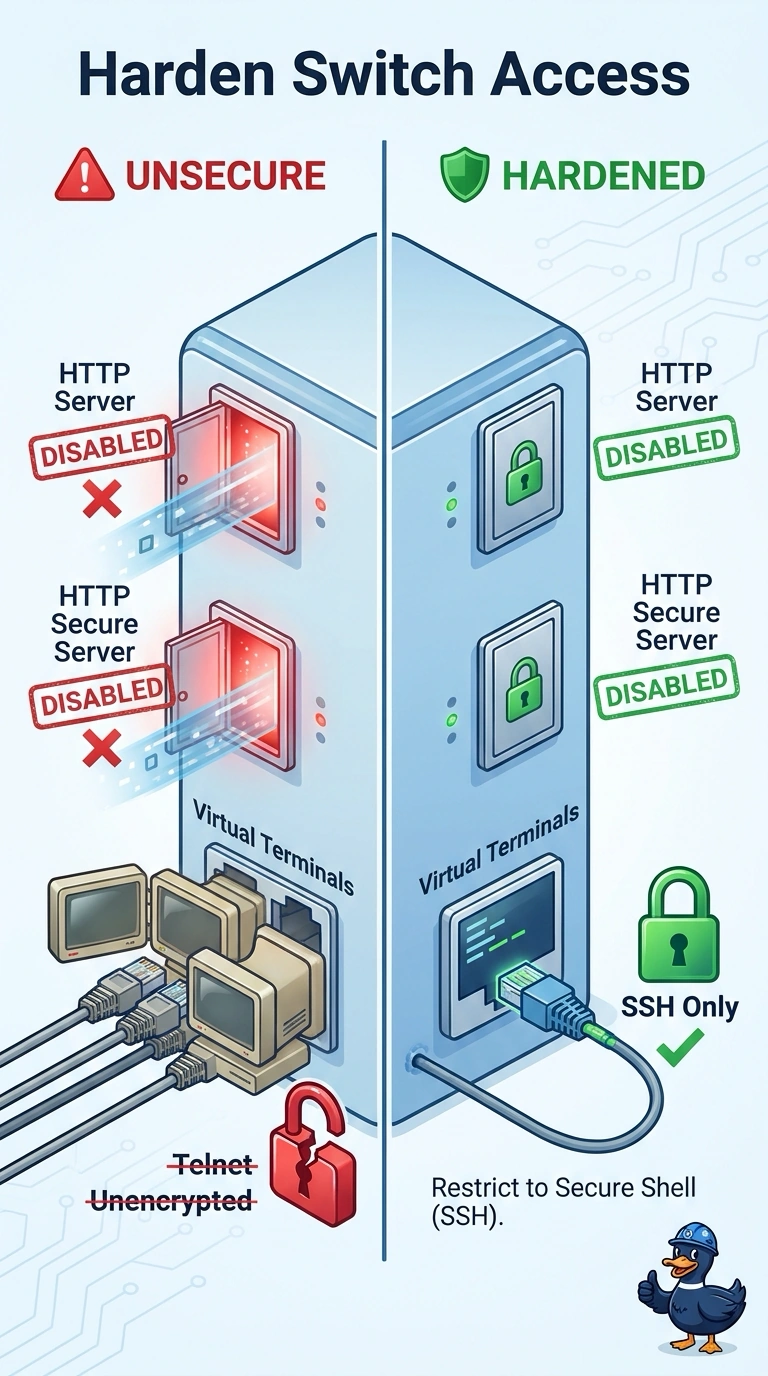
You already have SSH working for the engineers, so your baseline is to disable the HTTP and HTTPS servers and restrict virtual terminal access to SSH. Keeping the web interface for contractor convenience leaves an unnecessary management path, while turning off spanning tree or IP routing does not disable those services.
Full Explanation
Baseline hardening means removing management listeners you do not need while preserving the access path engineers already use. Since SSH is working, disable the HTTP and HTTPS servers with no ip http server and no ip http secure-server, and restrict virtual terminal lines with transport input ssh so Telnet is not accepted. Keeping the web interface enabled for contractors leaves an additional management surface exposed; convenience alone is not a reason to retain an unused service. Turning off spanning tree is unrelated: spanning tree prevents Layer 2 loops, and disabling it can contribute to a broadcast storm without closing HTTP or Telnet. Disabling IP routing is also unrelated to management listeners and could disrupt forwarding the cell depends on, while leaving those services available. Exam caveat: confirm that no required management workflow depends on the web interface before removing it, and apply the change to the management plane you control. Practical check: from a cell host, verify that browser access and Telnet to the switch fail, while an engineer can still connect through SSH.