
A reactor-cell PLC is the only device that should ever use port Gi1/3 on a Cisco Industrial Ethernet switch. Which port-security choice matches that baseline?
Select an answer to reveal the explanation.
Short Explanation
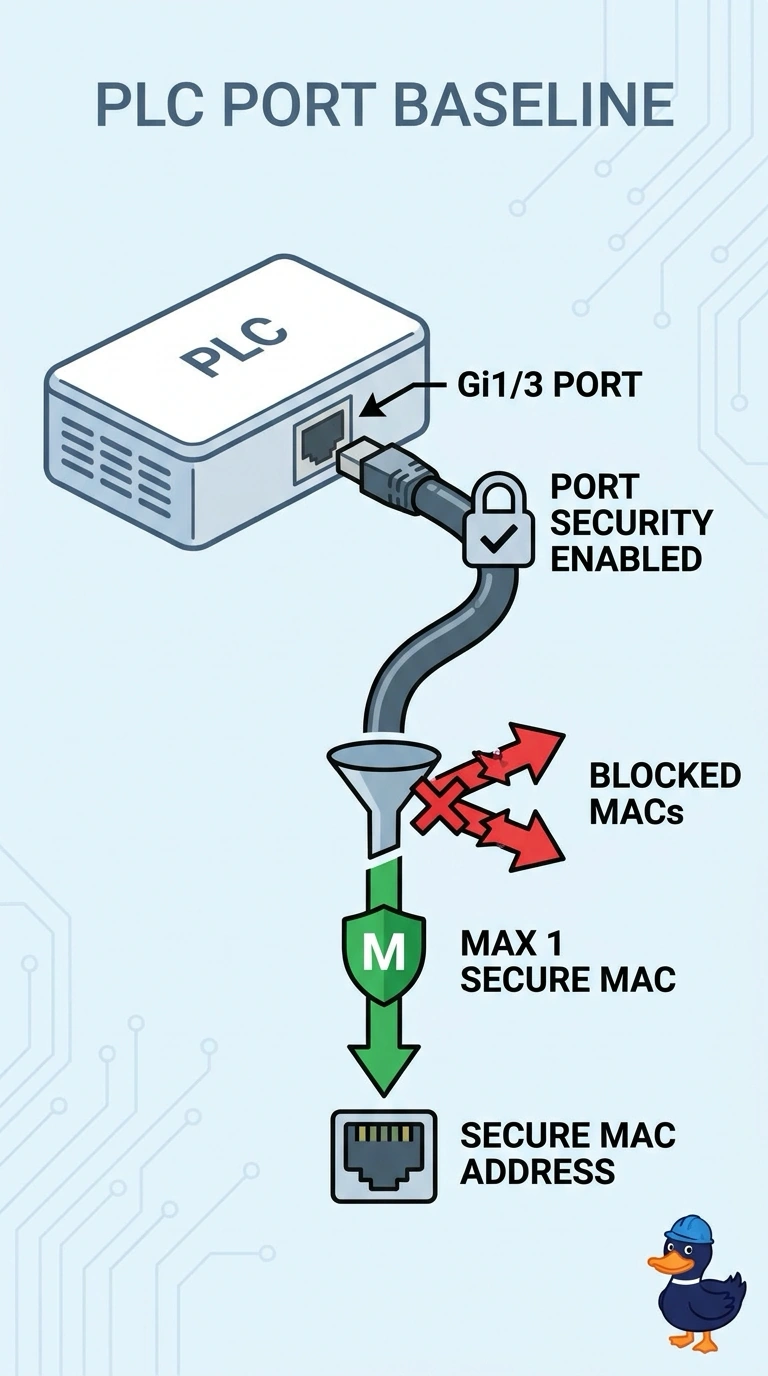
You can treat Gi1/3 as a reserved parking spot for one PLC, not a lot that grows with every device that parks. Set the secure MAC limit to one so a second device cannot join the conversation. A high limit or no port security leaves room for another device to connect.
Full Explanation
Because Gi1/3 should serve only the reactor-cell PLC, enable port security on the access port and set the maximum to one secure MAC address. The switch then treats an additional source MAC as a violation; the PLC’s address is the only one the port should learn or be assigned. A maximum of 50 allows many addresses, so a maintenance laptop could connect alongside the PLC. Sticky learning with a high maximum also retains a crowd of addresses and permits additional devices; sticky learning does not make a high limit restrictive. Leaving port security off and relying on storm control limits floods, not which MAC addresses may send frames, so a second device transmitting at a normal rate is not blocked by that control. Exam caveat: do not set a maximum of one on a trunk or uplink, which may carry many MAC addresses; doing so can err-disable a path the cell needs. Sticky learning of the PLC’s single address can be reasonable once you have verified the device, but the address survives a reload only if you save the configuration. As a practical check, run show port-security interface Gi1/3 and confirm the maximum is 1 and the PLC MAC appears as the secure address.