
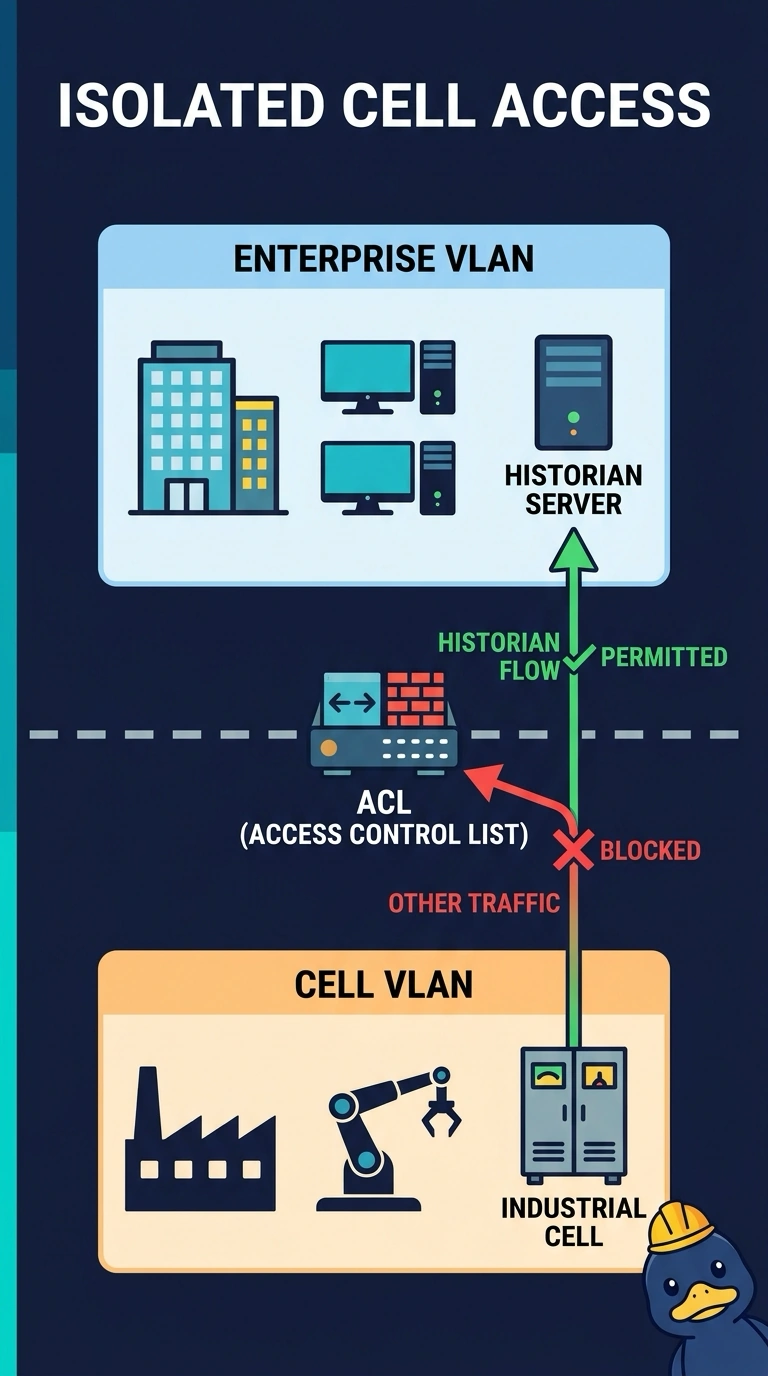
A factory must keep the robot-cell VLAN off the enterprise ERP VLAN, while still letting one historian query the cell. Which design matches that goal on Cisco Industrial Ethernet switches?
Select an answer to reveal the explanation.
Short Explanation
You can keep the robot cell separate from business systems and give the historian one permitted path with segmentation. A flat VLAN or an unrestricted trunk does not provide that separation, and port security on the ERP server does not control which IP conversations may cross.
Full Explanation
The matching design keeps the robot cell and enterprise ERP in separate VLANs and uses an ACL on the routed path to permit only the historian’s flow. The VLANs remain separate broadcast domains, and the ACL identifies the historian as the allowed peer rather than allowing the ERP subnet broadly. A flat VLAN stretched from the robot controllers to the ERP servers gives business hosts a Layer 2 path into the cell, defeating separation even though the historian can communicate without routing. A trunk that allows every VLAN across the core carries all of those VLANs, and without a filter facing the ERP gateway it does not restrict who may query the cell once routing exists. Port security limits MAC addresses on a switch port; it does not evaluate the robot-cell conversation as an IP flow or stop a routed historian query that is otherwise allowed. Exam caveat: an ACL on a switched virtual interface filters traffic routed through that interface, so two robots in the same cell VLAN can still communicate directly. Practical check: from an ERP host other than the historian, a connection to a cell PLC should fail, while the historian’s permitted ports should succeed. Use show ip access-lists to confirm hits on the intended permit and the implicit or explicit deny.