
Technicians telnet to a Cisco Industrial Ethernet switch on a building-automation network, and that management address sits on VLAN 1 with the controllers. Which baseline corrects this?
Select an answer to reveal the explanation.
Short Explanation
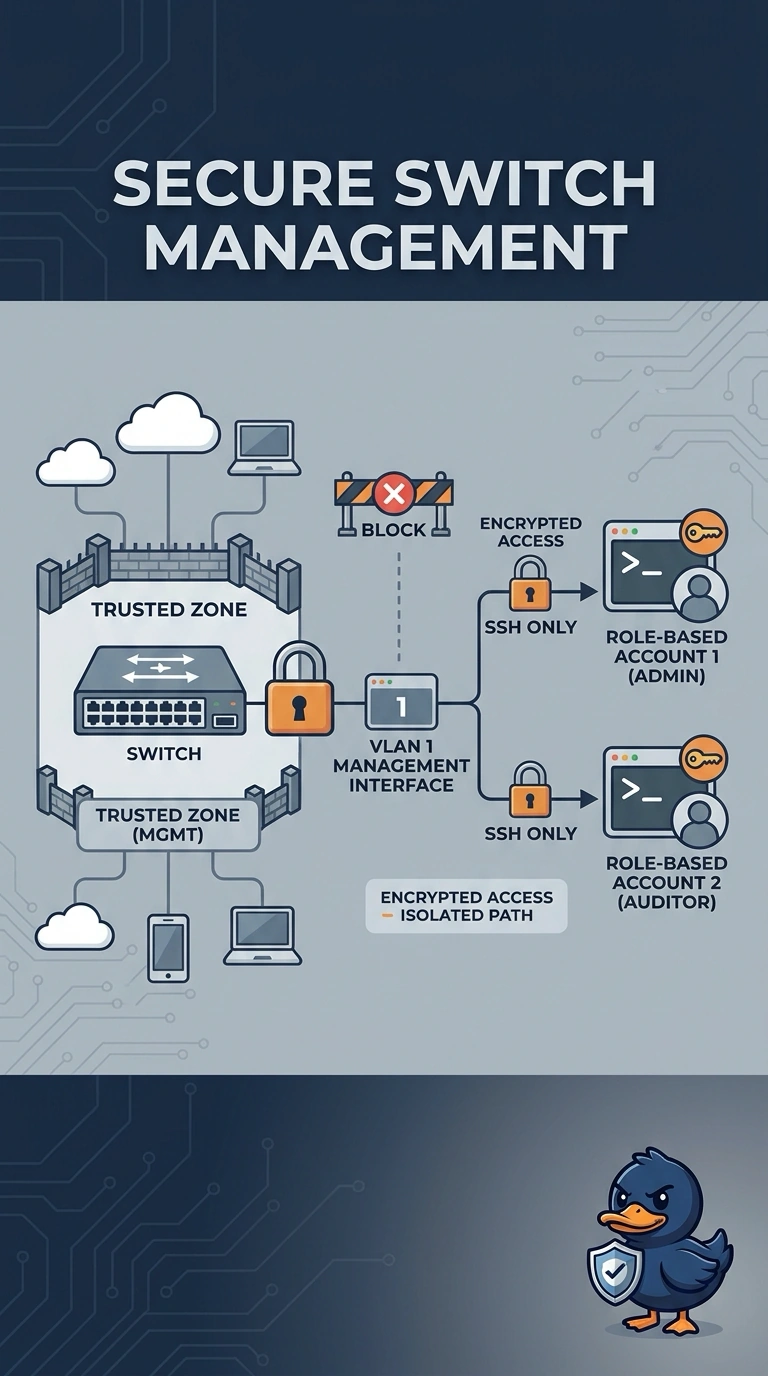
Managing the switch on the same VLAN as the controllers, over telnet, is like leaving the building keys on the front counter. You move management to its own VLAN and you make people use SSH with an account that matches their job. A posted password is not a role.
Full Explanation
Switch management should not share a broadcast domain with the controllers it runs, and it should not accept a cleartext remote shell. The baseline is a dedicated management VLAN with a switched virtual interface, remote access limited to SSH, and accounts that are not all full administrators. On IOS that means the VTY lines accept SSH only, SSH is version 2, and either privilege levels or AAA give an operator a smaller command set than an engineer. Telnet on VLAN 1 fails both the segmentation test and the encryption test. A shared enable secret printed in the banner discloses the credential to anyone who can see the login prompt, and it still leaves management beside the controllers. A closet SSID with a posted pre-shared key moves the same problem onto radio and does not create roles. Serving the switch web interface on the controller VLAN keeps management in the control plane's VLAN and adds a service the baseline turns off with no ip http server and no ip http secure-server. Exam caveat: the management VLAN still needs a path for the people who legitimately run the switch, usually from a hardened admin workstation, often limited by an access class on the VTY. Isolating management is not the same as making the switch unreachable during an incident. Operational check: from a controller VLAN host, telnet and HTTP to the switch should fail, and SSH from an operator account should not land in full privileged exec unless that role requires it.