
On a mining-site conveyor cell, several copper ports on a Cisco Industrial Ethernet switch have no devices cabled, yet they remain administratively up. Which baseline change should come first?
Select an answer to reveal the explanation.
Short Explanation
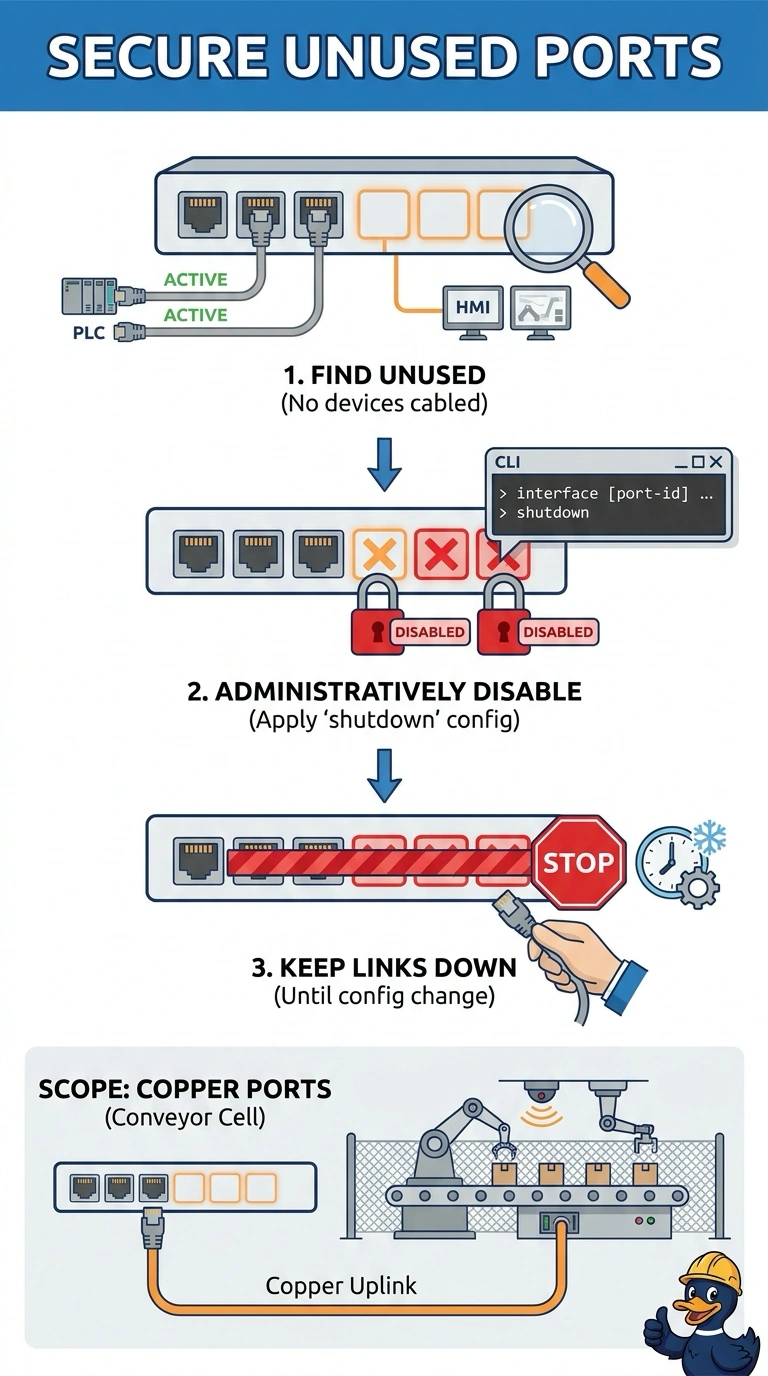
An open jack in a conveyor shack is an unlocked side door. You shut it until someone has a reason to use it, instead of leaving a live port for whatever gets plugged in on night shift. Speed and DHCP do not close that door.
Full Explanation
A secure baseline on a Cisco IE switch starts by removing places an attacker, or a well-meaning contractor, can get a link. An unused copper port that is still administratively up will come to line protocol up as soon as a cable and a device appear. The IOS action is to shut the interface down so the port stays dark until a change puts it in service. Enabling DHCP on those ports does the opposite: it prepares them to serve a stranger. Port speed does not control whether a device is allowed to attach, and forcing a high speed on an empty port does not harden it. Moving the empty ports into the VPN concentrator VLAN would place a future rogue device on a path toward remote access, which widens the exposure instead of closing it. Exam caveat: shut down ports you have confirmed are unused. A port that looks idle but feeds a spare PLC NIC or a temporary maintenance drop needs a label and an owner, not a blind shutdown in the middle of production. Operational check: compare show interfaces status with the panel drawing, shut the interfaces that have no cable and no owner, and save the configuration.