
A substation engineer wants protection trips between relays to ride IEC 61850 MMS across a routed link to the control center. The protection scheme uses native IEC 61850-8-1 Ethernet GOOSE. Which distinction fits?
Select an answer to reveal the explanation.
Short Explanation
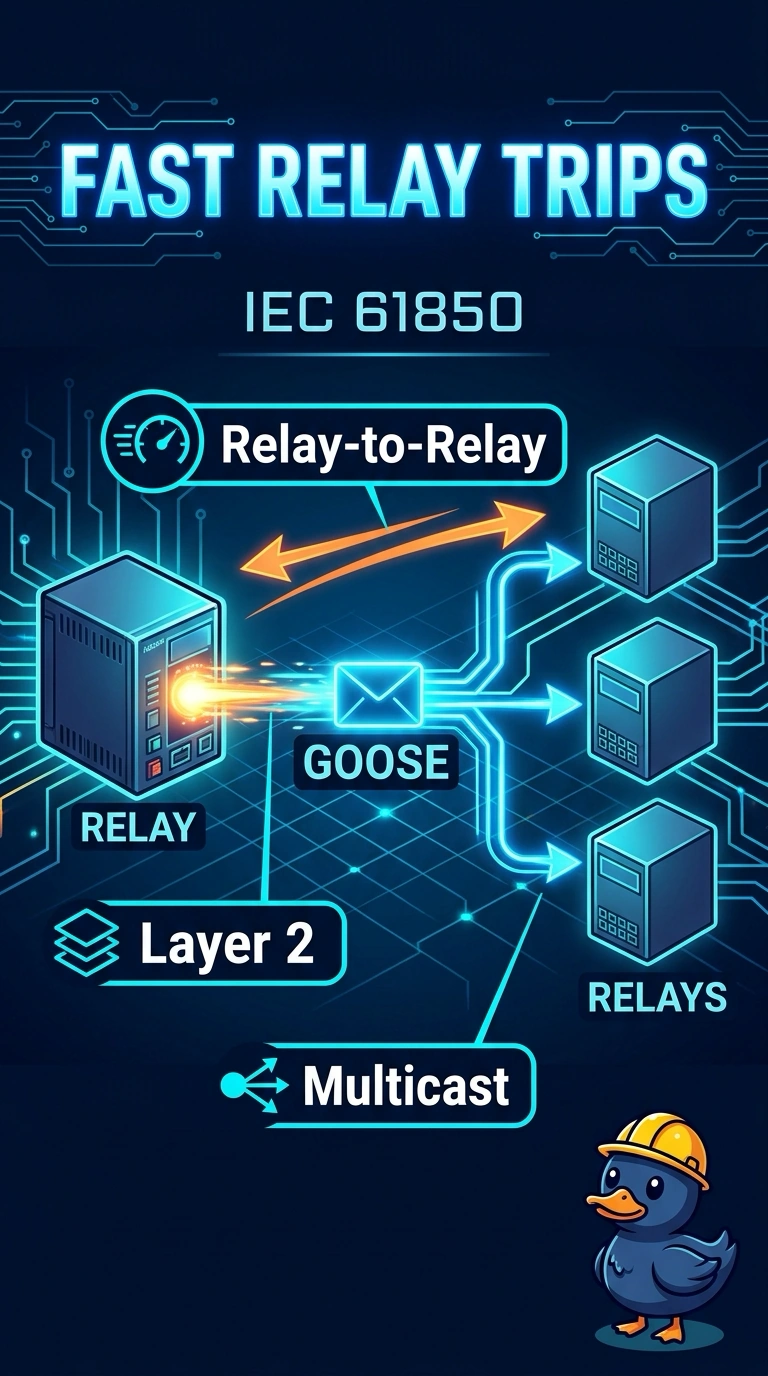
You want the relay trip to move quickly between peers on the substation LAN, not as a message to the control center. Use GOOSE for that Layer 2 multicast; MMS handles client/server supervision, while sampled values carry measurements rather than trips.
Full Explanation
IEC 61850 assigns different jobs to these mechanisms. Fast protection trips between relays use native GOOSE, a Layer 2 multicast service for peer-to-peer messages on the substation LAN. MMS is client/server communication carried over ISO-TSAP 102, used for supervisory access, reports, and file services; it is not the relay-to-relay trip path. A routed control-center link does not make native GOOSE routable: R-GOOSE is a distinct routable profile, so the restriction applies specifically to native Ethernet GOOSE. Sampled values stream measurements from instrument transformers; they do not carry the trip command or serve as a historian backup. EtherNet/IP implicit I/O on UDP port 2222 is a factory-automation transport, not a replacement for GOOSE in a substation protection scheme. GOOSE is also not a waveform-file transfer to the control center. Exam caveat: MMS can carry supervisory commands and reports between a control center and a substation device, but that is different from a fast trip between relays. Practical check: confirm that the protection diagram shows relay-to-relay trips as GOOSE on the substation LAN and the control-center connection as the supervisory MMS path, not as the trip path.