
An operator at a batch plant needs to acknowledge alarms on the HMI. A coworker wants that same login to force outputs and download logic. Which decision fits?
Select an answer to reveal the explanation.
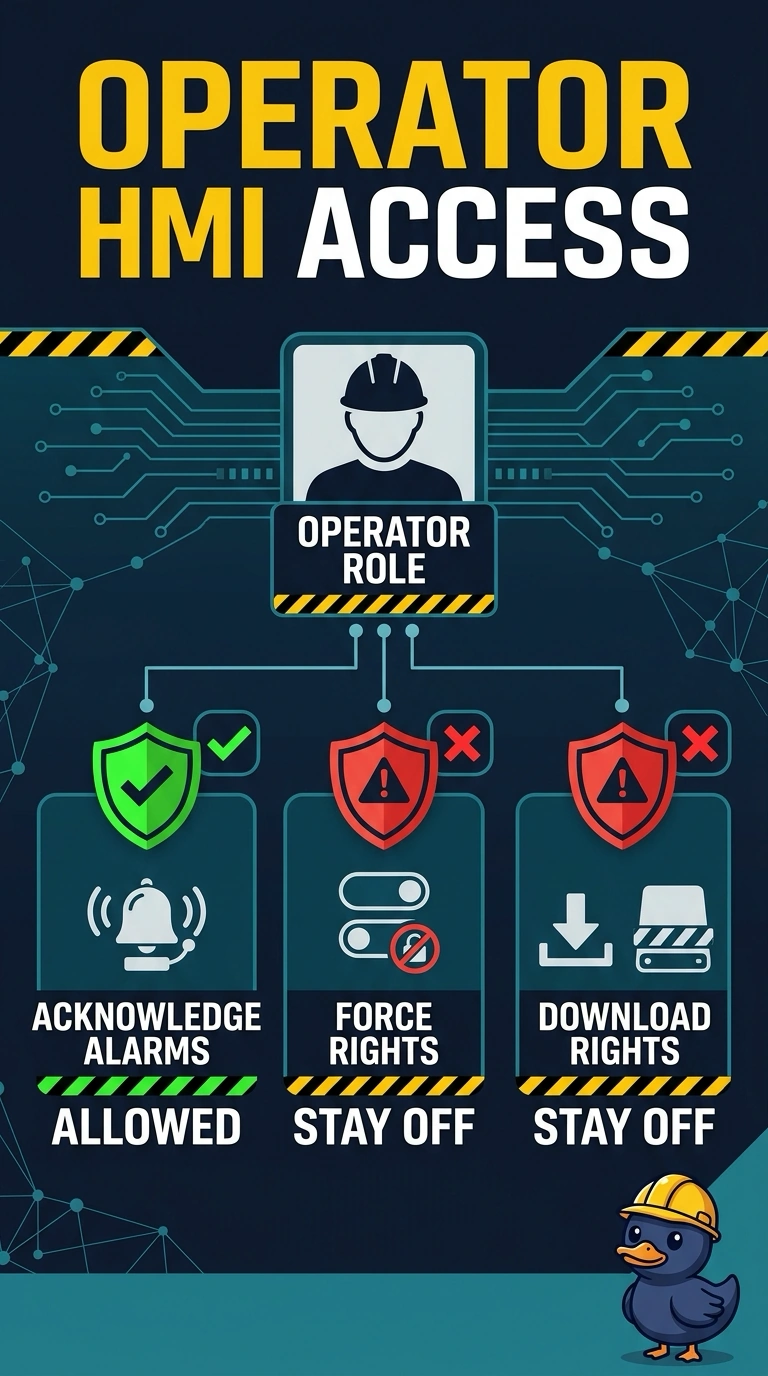
Short Explanation
You can let the operator acknowledge alarms while keeping force and download rights off that role. Acknowledging an alarm is raising your hand; forcing an output is grabbing the wheel. Even on a short shift, one login should not cover every job.
Full Explanation
Least privilege still applies on an HMI. The operator’s job is to see the process and acknowledge alarms, so retaining alarm acknowledgment while keeping force and download rights off the operator role fits the work and limits process-changing authority to people trained and authorized for it. Sharing the engineer’s login erases the record of who did which job; granting force and download to the operator login means anyone who can acknowledge an alarm can also override equipment. Removing alarm acknowledgment does not create least privilege—it blocks work the role is supposed to do. One caveat: a separate, monitored maintenance role may force outputs during an approved window. For a practical check, test the operator account: alarm acknowledgment should succeed, while force and download should be denied. Put before-and-after evidence in the work order, including the interface or account changed, the time, and the approver. On the next shift, confirm the original symptom is gone and the change did not open a second path while closing the first. If the process is still inside a live batch, leave the controller running and finish only work that does not restart it; this keeps a correct fix from becoming an unplanned outage.