
A new HMI can reach a PLC on its own IP subnet but cannot reach devices on other subnets. Its link, address, mask and access VLAN are correct. The design uses this VLAN’s SVI as the default gateway, but the HMI has another gateway address. Which fix comes first?
Select an answer to reveal the explanation.
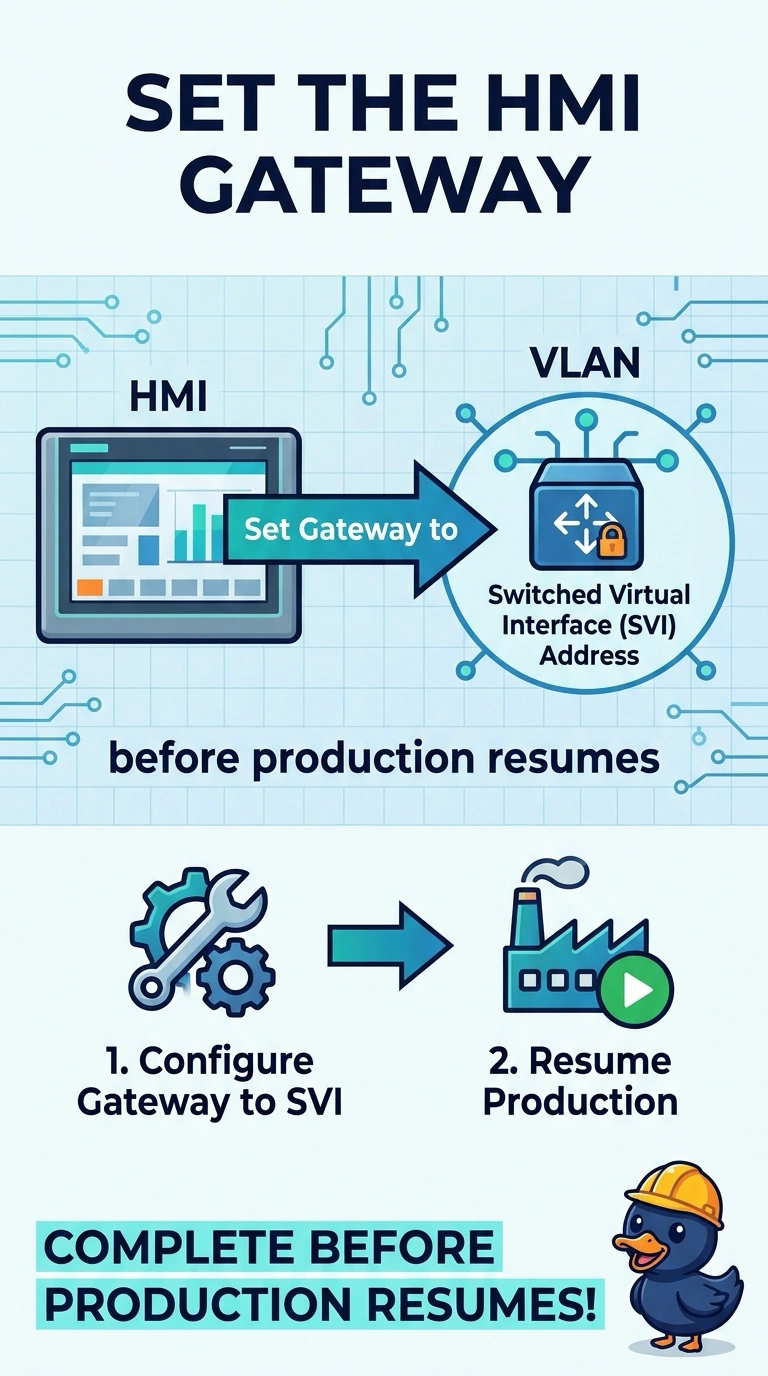
Short Explanation
The HMI is asking a neighbor who does not live on that street. You point its gateway at the SVI for its own VLAN. The trap is rebuilding the port when the address on the screen is simply wrong.
Full Explanation
Hosts use the default gateway to reach anything off their subnet. If that address is not the SVI for the VLAN, the HMI sends packets to a router that is not there. A wrong default gateway affects off-subnet routing, not normal communication between hosts on the same IP subnet. The port is already up in the right VLAN, so the Layer 2 attachment is not the first fault. Sticky learning records a MAC; it does not discover a gateway. Turning the port into a trunk does not invent a router. BPDU guard err-disables a port that receives BPDUs, and this port is up, so the gateway typo is not an err-disable cause. The caveat is to check the mask as well as the gateway, because a wrong mask can point the HMI at the SVI for the wrong subnet. The check is a ping to the SVI address after the HMI is corrected, then a ping onward to the PLC. Put the before-and-after evidence in the work order, including the interface or account you changed, the time, and the person who approved it. On the next shift, confirm the original symptom is gone and that the change did not open a second path while closing the first. If the process is still inside a live batch, leave the controller running and finish only the part of this work that does not restart it. That sequence keeps a correct fix from turning into an unplanned outage.