
After a switch change, hosts inside VLAN 20 still reach each other and hosts inside VLAN 30 still reach each other, but nothing routes between them. The VLAN 30 interface is administratively down. Which fault fits?
Select an answer to reveal the explanation.
Short Explanation
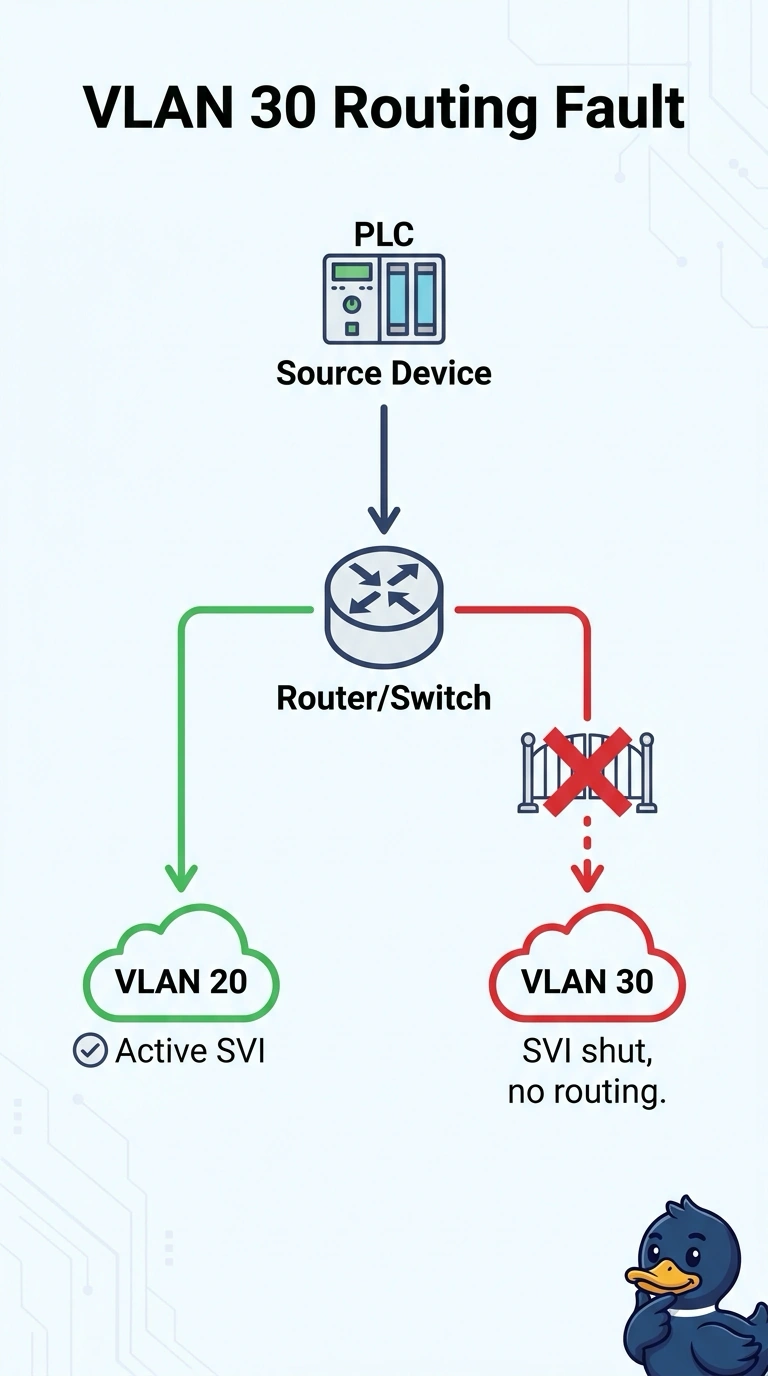
You can see that hosts in each room still talk, but the route between the rooms is unavailable. The SVI for VLAN 30 is shut, so it cannot provide the Layer 3 endpoint needed to route traffic to that VLAN. DNS trouble or err-disabled access ports would not fit the working conversations within both VLANs.
Full Explanation
On a multilayer switch, routing to a VLAN uses that VLAN’s switched virtual interface (SVI). Because the VLAN 30 interface is administratively down, the switch has no active Layer 3 endpoint for VLAN 30, so hosts in VLAN 20 cannot route to hosts in VLAN 30. Hosts within VLAN 30 can still communicate at Layer 2, as can hosts within VLAN 20, matching the symptoms. A DNS failure for the PLC name would not explain the loss of routed connectivity while intra-VLAN communication remains available; DNS is not required for host-to-host sessions by address. Port security that places access ports in an err-disabled state would stop those ports from passing intra-VLAN traffic, contrary to the reported connectivity. A native VLAN mismatch is associated with trunking and does not by itself shut the VLAN 30 SVI or explain this administratively down interface. Exam caveat: bringing the SVI up restores routing only if no separate policy, such as an ACL on the SVI, denies the flow. Practical check: issue no shutdown on interface VLAN 30, confirm that it is up with the correct address, and test connectivity from VLAN 20 to a VLAN 30 PLC.