
After a trunk edit at a printing plant, press HMIs on switch A cannot reach PLCs on switch B, while devices on the same switch still communicate in the cell VLAN. Which cause fits?
Select an answer to reveal the explanation.
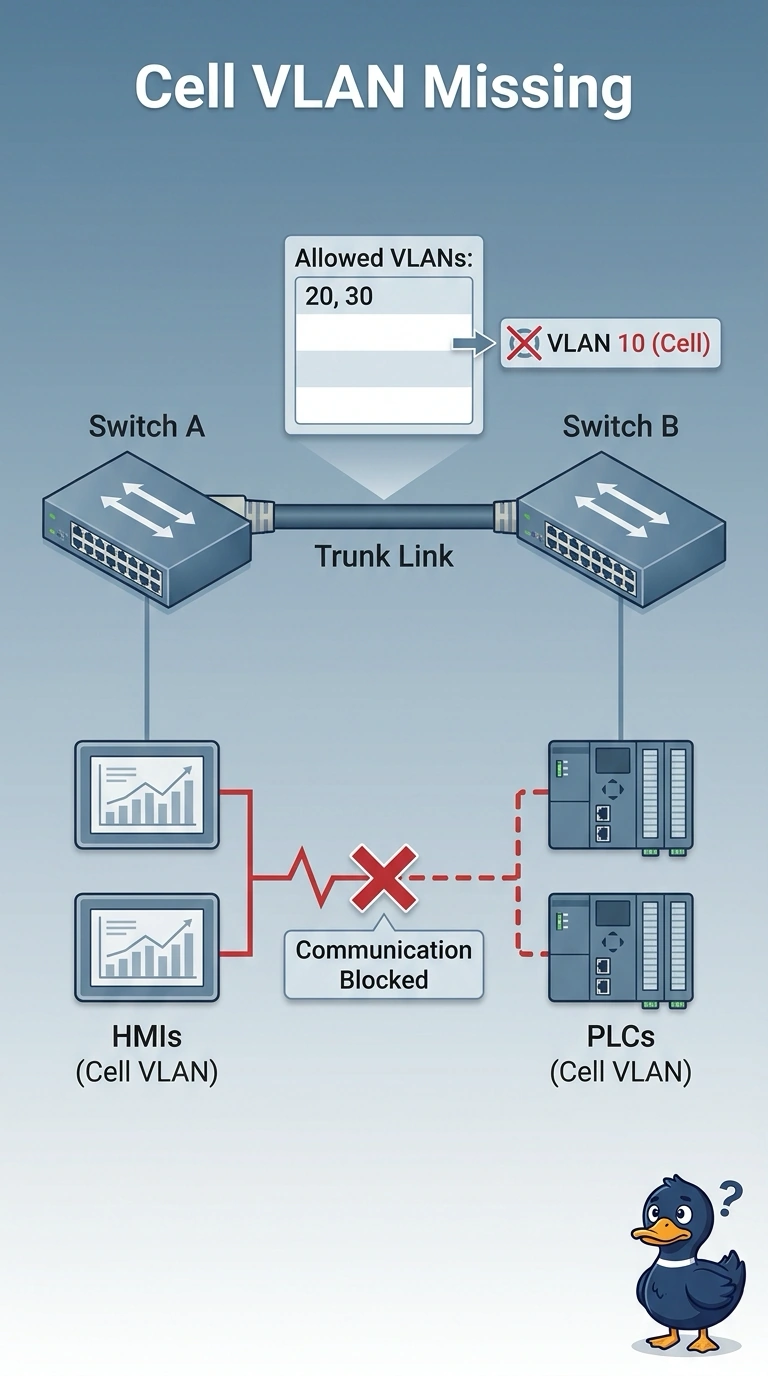
Short Explanation
The two switches are buildings, and the trunk is the bridge that no longer carries this floor. You check the allowed VLAN list before you blame names or a gateway that same-VLAN traffic does not use. Devices that still talk inside one switch tell you the local ports are up.
Full Explanation
Hosts in the same VLAN on two switches talk across the trunk. If a trunk edit removes the cell VLAN from the allowed list, frames for that VLAN stop at the trunk, and HMIs on switch A lose the PLCs on switch B. Devices on the same switch never need the trunk, so they keep communicating. That split is the signature of the cell VLAN missing from the trunk. A wrong default gateway does not explain it. Hosts in the same VLAN exchange frames at Layer 2 and do not use the gateway for that conversation. Name resolution is not on the path if the HMIs call controllers by address, so a DNS failure would not produce this outage. An access list on the cell switched virtual interface filters traffic routed through that interface. It does not filter frames that stay inside the VLAN, and cross-switch traffic in one VLAN is bridged. If that list were the cause, same-VLAN traffic would still pass across the trunk. Exam caveat: confirm the VLAN is absent from the allowed list before you widen the trunk to every VLAN. Restoring only the cell VLAN is the change that matches the symptom. Operational check: show the trunk and expect the cell VLAN missing from the allowed set, add that VLAN back, and confirm an HMI on switch A reaches its PLC on switch B again.