
An engineer already on the plant VPN wants to download logic to one cannery filler PLC. The site standard is zero-trust access. Which process should the system follow?
Select an answer to reveal the explanation.
Short Explanation
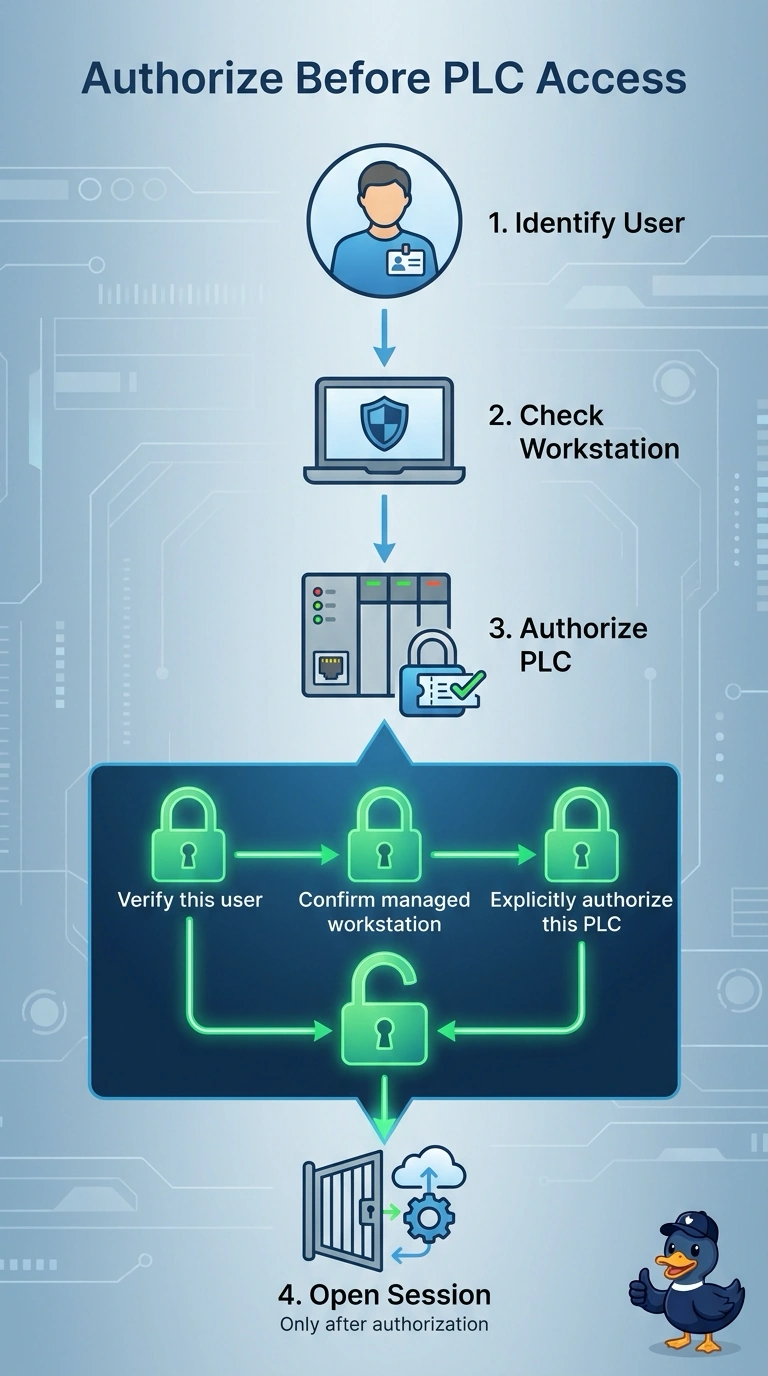
The VPN gets you to the plant gate, but zero trust does not treat that as permission to reach the filler PLC. You still check this person, this managed laptop, and an explicit authorization for this controller. Last month’s successful download is history, not permission for this session.
Full Explanation
Zero-trust access removes network location as a basis for authorization. Being on the plant VPN proves the engineer passed the VPN’s checks; it does not prove this session may change logic on the filler PLC. Before opening the session, the system should verify this user, the managed workstation’s posture, and explicit authorization for this PLC, then scope access to that action. Allowing the download simply because the VPN placed the laptop inside the trusted plant network confuses connectivity with permission and restores implicit trust. Allowing it because the engineer downloaded logic successfully last month treats past access as a standing exception; a previous success does not authorize a new session. Letting anyone who joins the engineering wireless LAN program every PLC trusts shared network access rather than verifying a user and a specific asset, and grants far broader access than this task requires. Least privilege means authorization for this PLC, not every controller the VPN can reach. Exam caveat: explicit authorization must remain workable during an identity-service outage; a monitored break-glass path for a named engineer can be part of the design, but an open engineering LAN is not a substitute. Practical check: review the filler PLC’s access policy and confirm that a VPN-connected engineer without current approval is denied, while an approved session is logged against both the user and the asset.