
A rail crew shares one password for a wayside HMI, and the password is written inside the cabinet. After an incident, nobody can say who sent a command. Which practice closes that gap?
Select an answer to reveal the explanation.
Short Explanation
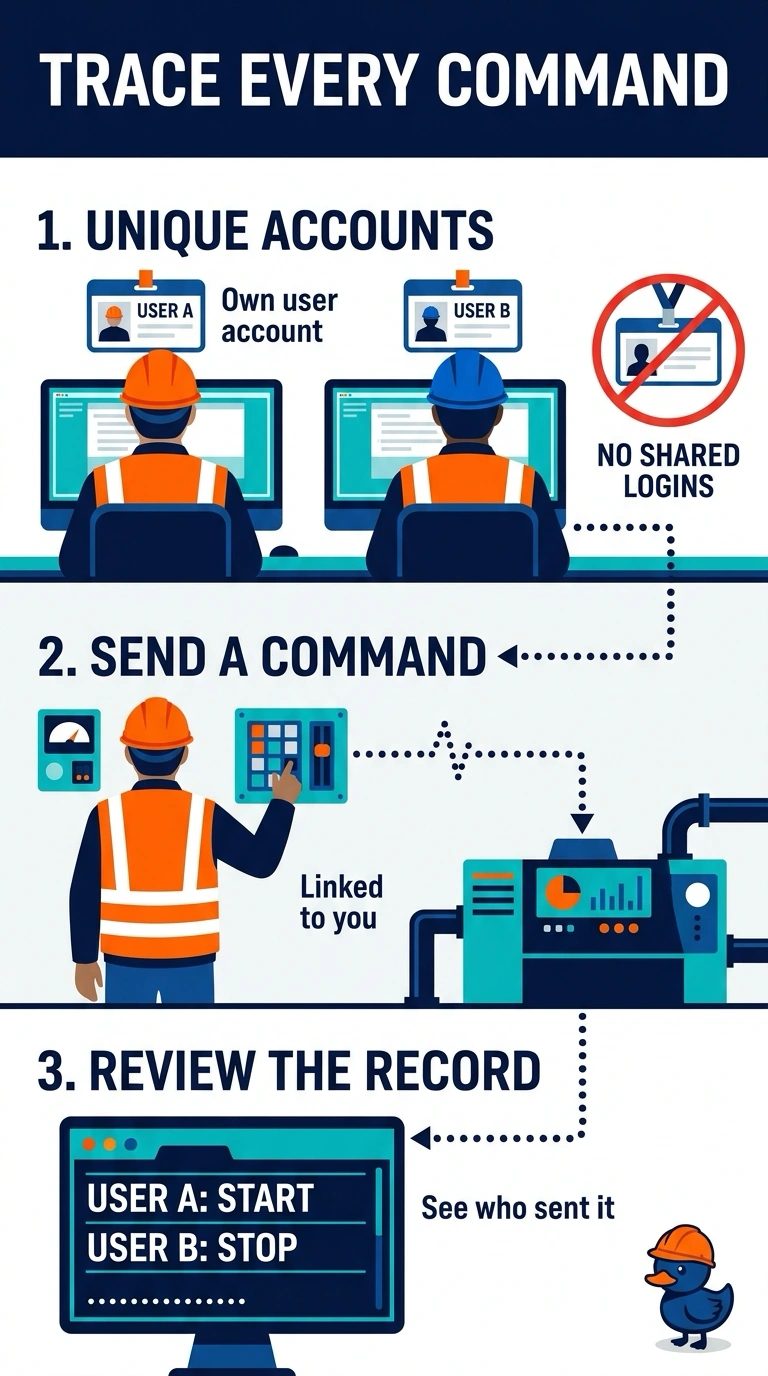
A shared cabinet password is like one coat-check ticket for the whole crew: when something moves, you cannot tell whose hand was on it. Give each person a named login, so accountability does not depend on a longer shared secret.
Full Explanation
Access control in an industrial network has to answer who did what, not merely whether someone who knew a secret got in. A wayside HMI that accepts one shared password may show a command in its log, but it cannot attach that command to a particular person. Unique user accounts give each authorized operator an identity the event record can store, which is what an incident review needs. A longer shared password, rotated yearly and left on a card in the cabinet, preserves the same anonymity and gives anyone who opens the door a convenient copy. Posting the HMI IP address may help responders find the cabinet faster, but it does not identify who sent a command. Disabling the HMI event log removes the record entirely, widening the accountability gap even if the screen draws with less delay. Exam caveat: some older HMIs cannot support individual accounts. A compensating pattern is a jump host or badge-gated session in front of the HMI that records the person, rather than returning to a shared secret. Practical check: send a test command and confirm that the HMI, or the broker in front of it, records a distinct user; also remove the written password from the cabinet.