
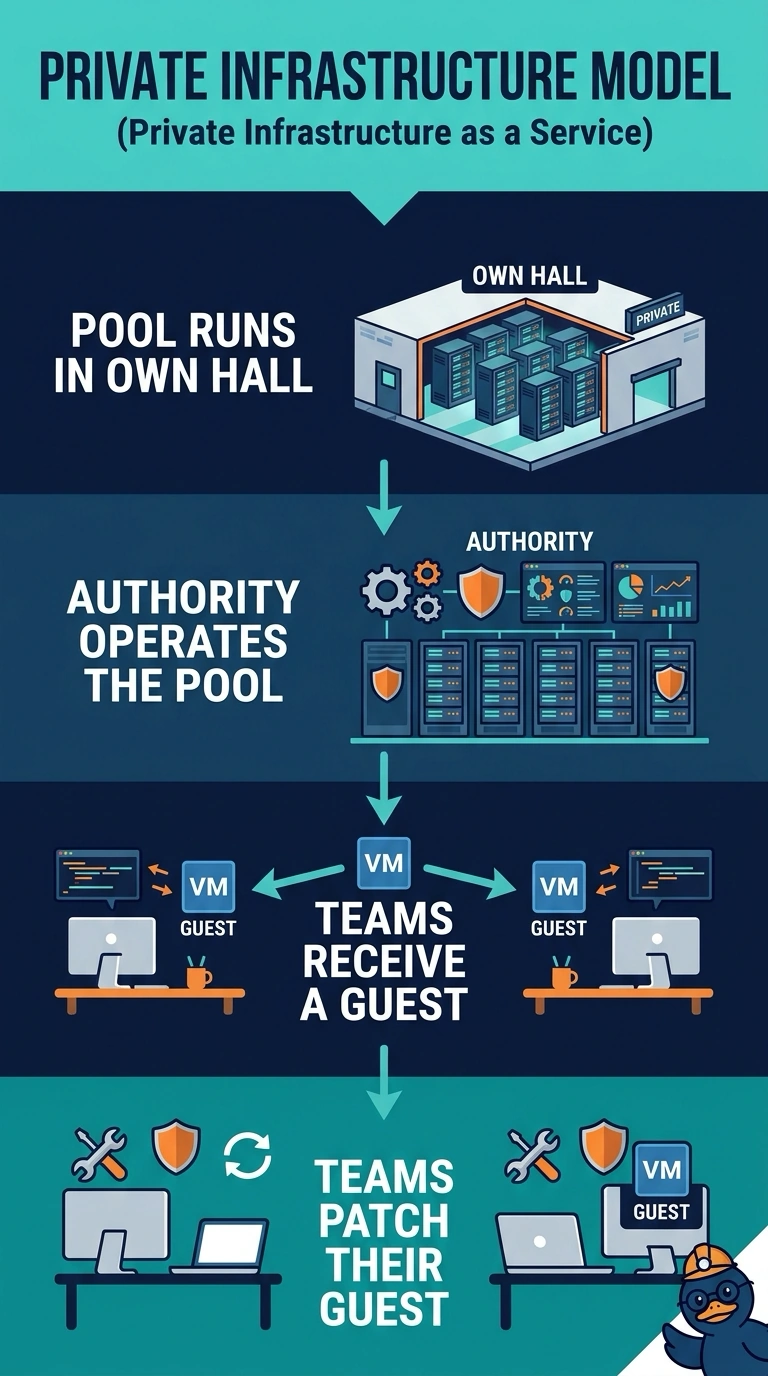
A port authority runs the compute pool inside its own hall and hands each terminal team a guest that the team patches. No outside operator takes a burst pool. Which model is that?
Select an answer to reveal the explanation.
Short Explanation
Think of a workshop you own for your crews alone, where each crew still patches its own bench. You are in private infrastructure as a service because the pool is for the authority's exclusive use and the teams patch the guests. Public, software as a service, and hybrid burst designs each change exclusive use, what you receive, or add a second connected cloud.
Full Explanation
Private infrastructure as a service means the teams still receive guests to patch on a pool provisioned for exclusive use. The port authority runs the pool in its own hall, and each terminal team patches its guest. No outside operator runs a burst pool. A private cloud is provisioned for exclusive use by an organization and can be operated by that organization or a third party. A hybrid cloud combines distinct, connected clouds; bursting is one example. Public infrastructure as a service would serve general users with a provider-operated pool. Software as a service would hand over only an application. A hybrid model would add a second connected cloud. Private infrastructure as a service, with the authority operating the pool and the teams patching guests is the design that meets this requirement. Public infrastructure as a service, with an outside provider operating the pool the teams patch is the wrong fit because that model lacks exclusive use by the authority. Software as a service, with the teams receiving only a finished application and no guest is the wrong fit because software as a service would give the teams only a finished application, not a guest they patch. A hybrid model, with a second operator running a burst pool beside the authority pool is the wrong fit because a hybrid model would combine distinct, connected clouds, and no second connected cloud is in this design.