
A lawful-intercept probe ships as a kernel module that the shared host kernel will not load, and private namespaces do not give it another kernel. Which runtime should run the probe?
Select an answer to reveal the explanation.
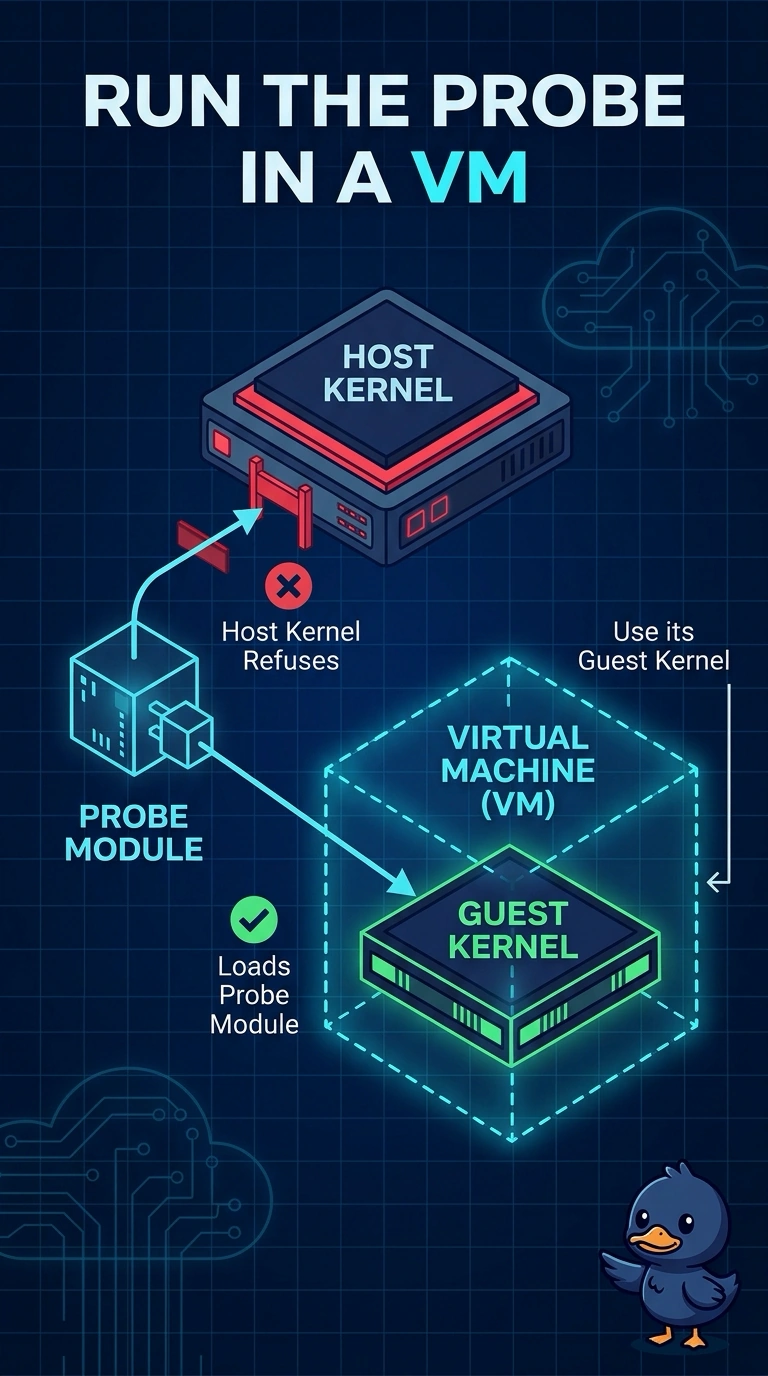
Short Explanation
A private engine can burn a fuel the shared bus will not carry, while a passenger seat cannot. You run this probe in a virtual machine so its guest kernel can load the module the host refuses. A container, a namespaced container, and a host process all stay on the kernel that will not load it.
Full Explanation
A virtual machine carries its own guest kernel, so a probe can load a module the host kernel will not accept. A container, a second container with its own network namespace, and a supervised host process all share that host kernel. Namespaces change what the process can see. They do not install a different kernel. This probe needs the guest boundary a virtual machine provides. A virtual machine whose guest kernel can load the probe module the host kernel refuses is the design that meets this requirement. A container scheduled on the shared host kernel that the probe module is not allowed to change is the wrong fit because a container shares the host kernel, and this probe needs a kernel the host will not load for it. A second container whose private network namespace still runs on that same shared host kernel is the wrong fit because a private network namespace still uses the host kernel, so the refused module remains impossible to load. A supervised process on the host kernel beside other containers, with no guest kernel of its own is the wrong fit because a host process is scheduled on the same kernel that refuses the module and adds no guest kernel at all. Exam caveat: Choose a container when the workload is a process-level unit built for the host kernel, because a virtual machine is extra weight when no separate kernel is required. Operational check: On the guest, load the probe module and confirm it appears only inside that guest while the host kernel module list stays unchanged after boot.