
A prepaid rating function in a mobile core is one process that any worker with the same kernel should start, stop, and move, and that move must not wait for a guest operating system to boot. Which placement matches the requirement?
Select an answer to reveal the explanation.
Short Explanation
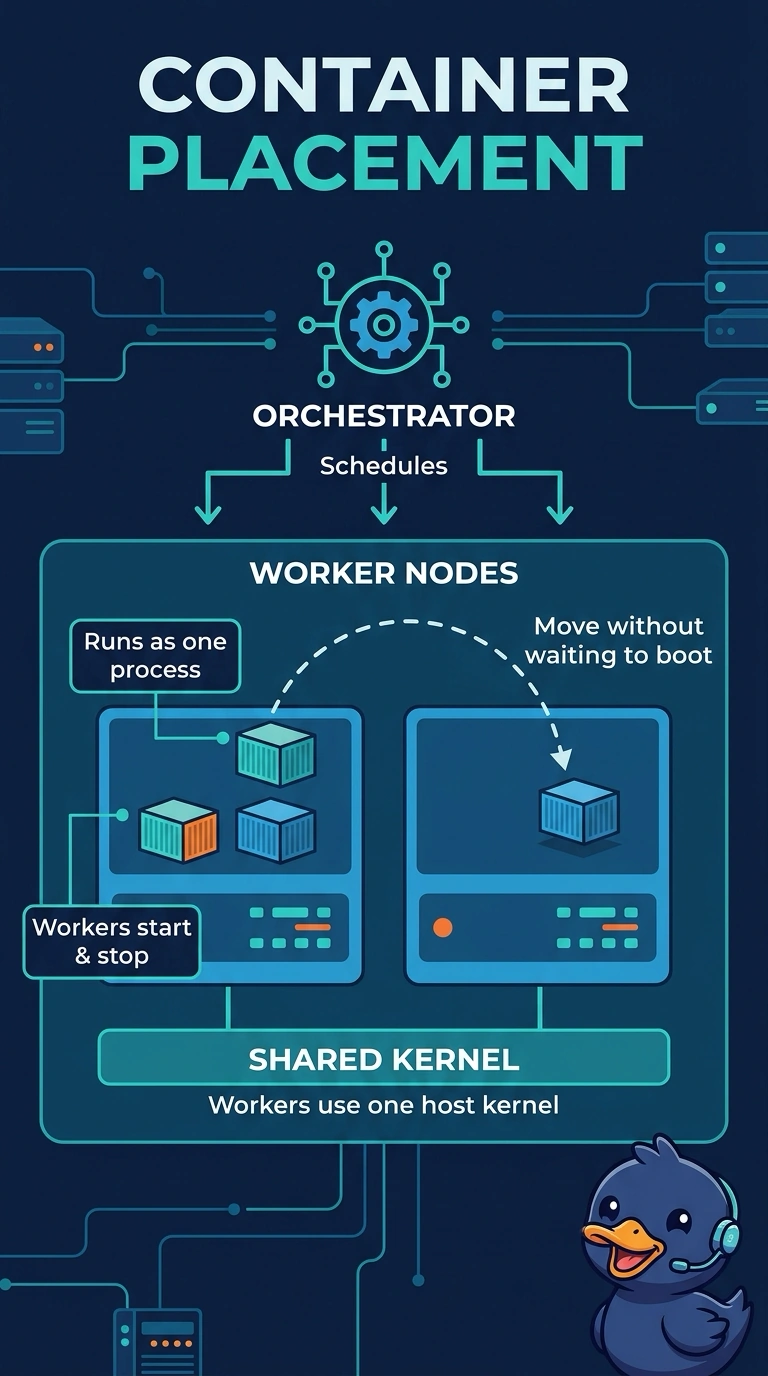
A container is like a labeled lunchbox on a shared kitchen counter: your meal moves without building a second kitchen. You want the rating task started as a process on the worker kernel, so that container is the unit that fits. A virtual machine, a nested hypervisor, and a bare-metal rebuild each force a separate machine to boot or reinstall.
Full Explanation
A container shares the worker kernel and starts as a process. Run the workload in a container. In Kubernetes, the scheduler places a Pod containing the container on a node. Rescheduling starts a replacement instance; it does not imply migration of the running process. The prepaid rating function fits that model because any worker with the same kernel can start it, stop it, and start a replacement elsewhere without a guest boot cycle. A virtual machine that boots a separate guest kernel and its own operating system disk is the wrong fit because it boots a private guest kernel and disk for a task that can share the worker kernel. A nested hypervisor that starts a full guest machine for every individual rating process is the wrong fit because it adds another hypervisor and a guest boot for each task when only Pod placement is needed. A bare-metal server rebuilt from install media whenever the rating process must move is the wrong fit because it ties the task to hardware reinstall instead of a replaceable process. Exam caveat: A container shares the host kernel, so switch to a virtual machine if a later build must load its own kernel modules or keep a hard boundary from neighbors. Operational check: Confirm the orchestrator shows the rating function as a container on a worker node and that the start record includes no guest operating system boot.