
A city tax calculator must run on an event after each completed return upload, must not leave a guest or a standing runtime to patch, and the city will not operate the pool. The provider may reuse the execution environment between events. Which model fits?
Select an answer to reveal the explanation.
Short Explanation
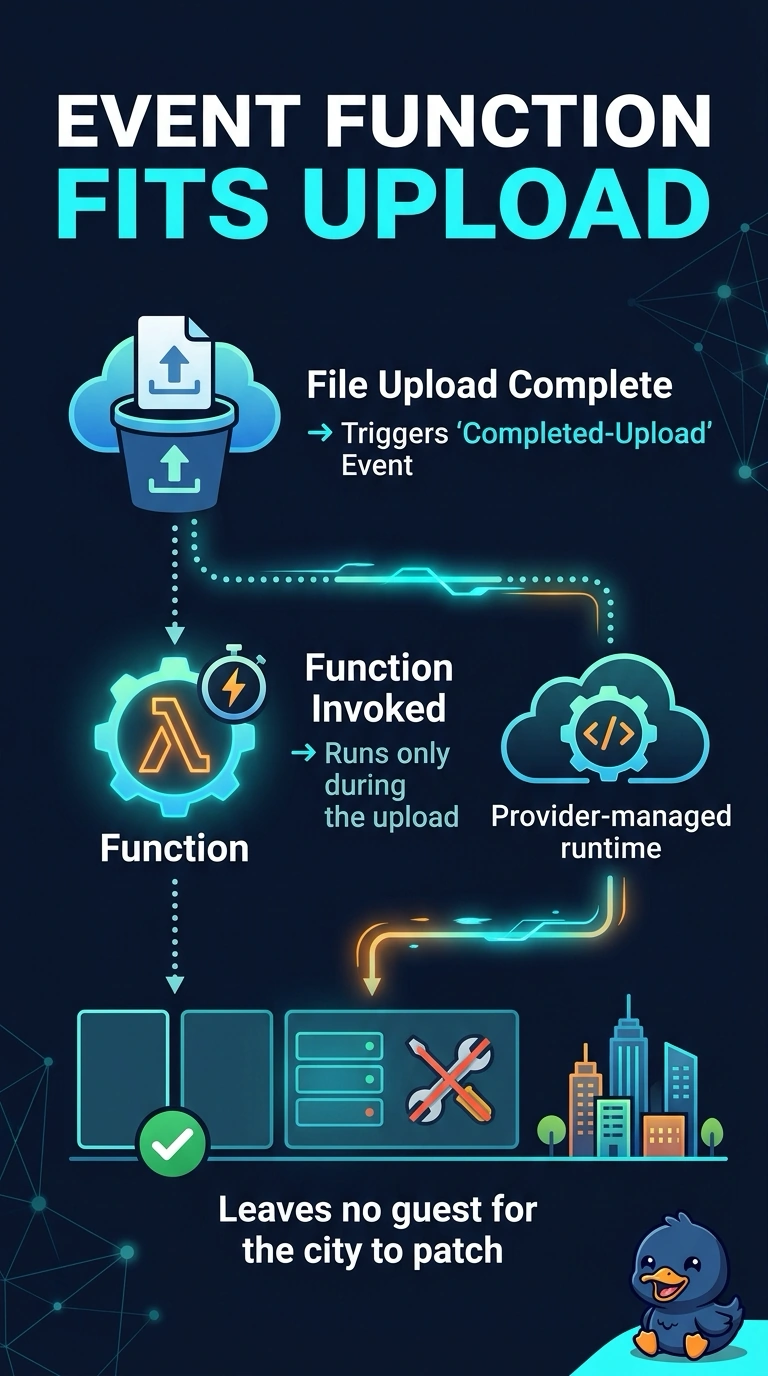
Think of a pop-up stall you open for each sale rather than a store you keep lit all week. You can use a function invoked by the completed-upload event, with the provider managing its runtime, and the provider may reuse the execution environment between events. A guest operating system you patch, a standing platform runtime, and a private pool you operate do not fit that event-driven need.
Full Explanation
Function as a service runs code for an event with the provider managing its runtime, and the provider may reuse the execution environment between events. The city needs an event function on infrastructure it does not operate, so use a function invoked by the completed-upload event, with the provider managing its runtime meets the requirement because it triggers after each completed return upload without leaving a guest to patch. Infrastructure as a service that hands the city a guest operating system and expects the city to patch it fails because the city would have to patch that guest between uploads. A standing platform runtime the city deploys the calculator onto and leaves running between uploads fails because it remains deployed between events rather than being invoked per completed upload. A private pool the city itself operates, changing only who runs the underlying infrastructure, fails because operating a private pool does not define an event-invoked function with no guest to patch. Exam caveat: A private pool does not determine the service model, and a platform runtime can still be right when an application must stay deployed. Practical check: After an upload finishes, confirm no guest remains to patch, then submit another file and confirm the function runs again.