
A national railway operator needs a Layer 3 VPN service definition applied across many provider edge routers. NSO maps one service definition to the device-specific configuration required on each participating router. An engineer proposes logging into one router CLI to type the config. Which action orchestrates the service intent across all devices?
Select an answer to reveal the explanation.
Short Explanation
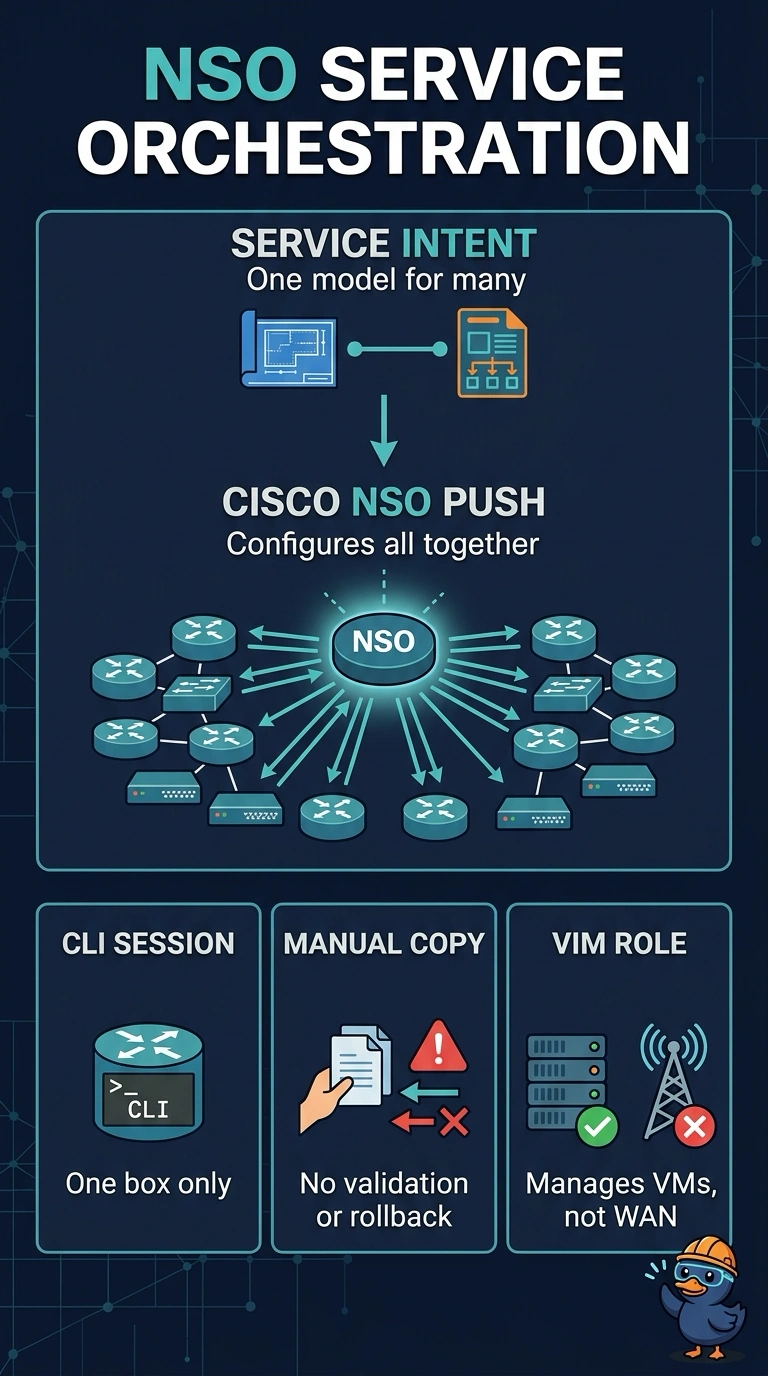
You want one intent to land everywhere, not box-by-box typing. Push the service intent with Cisco NSO as your orchestration and configuration system across devices. You get consistency and scale instead of single-device CLI work.
Full Explanation
Cisco NSO is the orchestration and configuration system that translates service intent into device configuration across many devices. Pushing service intent with Cisco NSO as the orchestration and configuration system across devices is correct because a single service model drives consistent configuration with transaction control and reconciliation, rather than per-box effort. This fits the railway need because NSO maps one service definition to the device-specific configuration required on each participating router. Opening a single-device CLI session to configure one router at a time without central orchestration is the wrong fit because it affects only the connected device with no service model, no cross-device transaction, and no scale. Copying a local config file between routers by hand without a service model or transaction control is the wrong fit because it lacks validation, service-to-device tracking, and consistent rollback if part of the rollout fails. Driving the OpenStack VIM as if it were the WAN service orchestrator for router configuration is the wrong fit because the VIM manages compute and virtual networks for instances and is not the configuration system for WAN services. Operational check: in NSO confirm the service is in-sync across all devices before closing the rollout.