
Tenants bring overlapping address plans, and unused 802.1Q identifiers remain well inside the usable range. One shared routing table cannot hold two copies of the same prefix. How should tenancy be separated?
Select an answer to reveal the explanation.
Short Explanation
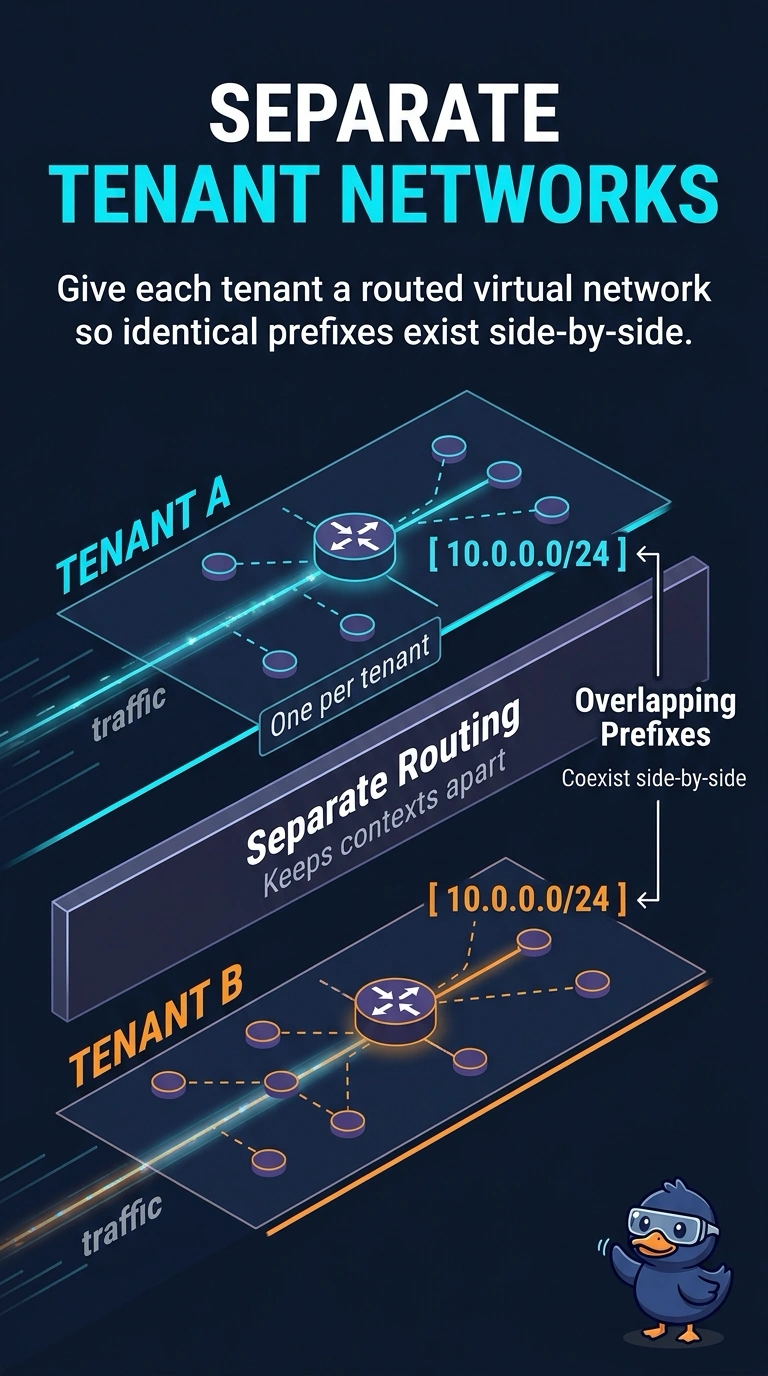
Two buildings can both use the number 10 if each building has its own directory. You give each tenant a routed virtual network so the same prefix can exist twice. Unique VLANs in one routing table, one stretched VLAN, and an overlay that keeps a single table still collide.
Full Explanation
Usable 802.1Q identifiers run from 1 through 4094, and this cloud still has spares. The constraint is overlapping tenant prefixes in one routing table. Separate VLANs do not fix that if they share one table. One stretched VLAN is a single broadcast domain. An overlay that keeps that same table keeps the collision. Each tenant needs its own routed virtual network. Give each tenant a routed virtual network so identical prefixes can exist side by side is the design that meets this requirement. Give each tenant a unique bridged VLAN and keep all of them in one routing table is the wrong fit because A unique VLAN still feeds one routing table, and that table cannot hold two copies of the same prefix. Stretch one VLAN across every tenant so all hosts share one broadcast domain is the wrong fit because One stretched VLAN puts every tenant in one broadcast domain and does not separate overlapping plans. Move the same single routing table into an overlay without a table per tenant is the wrong fit because An overlay that keeps a single routing table still cannot store identical tenant prefixes side by side. Exam caveat: The usable 802.1Q range is 1 through 4094. Spare VLAN identifiers do not let one shared routing table store two copies of the same tenant prefix. Operational check: Install the same prefix in two tenant routing tables and confirm each table forwards only to its own tenant without mixing the address plans.