
A design review labels a cloud-hosted virtual route reflector as the orchestration system for a mobile core. What is that reflector in the virtualized architecture?
Select an answer to reveal the explanation.
Short Explanation
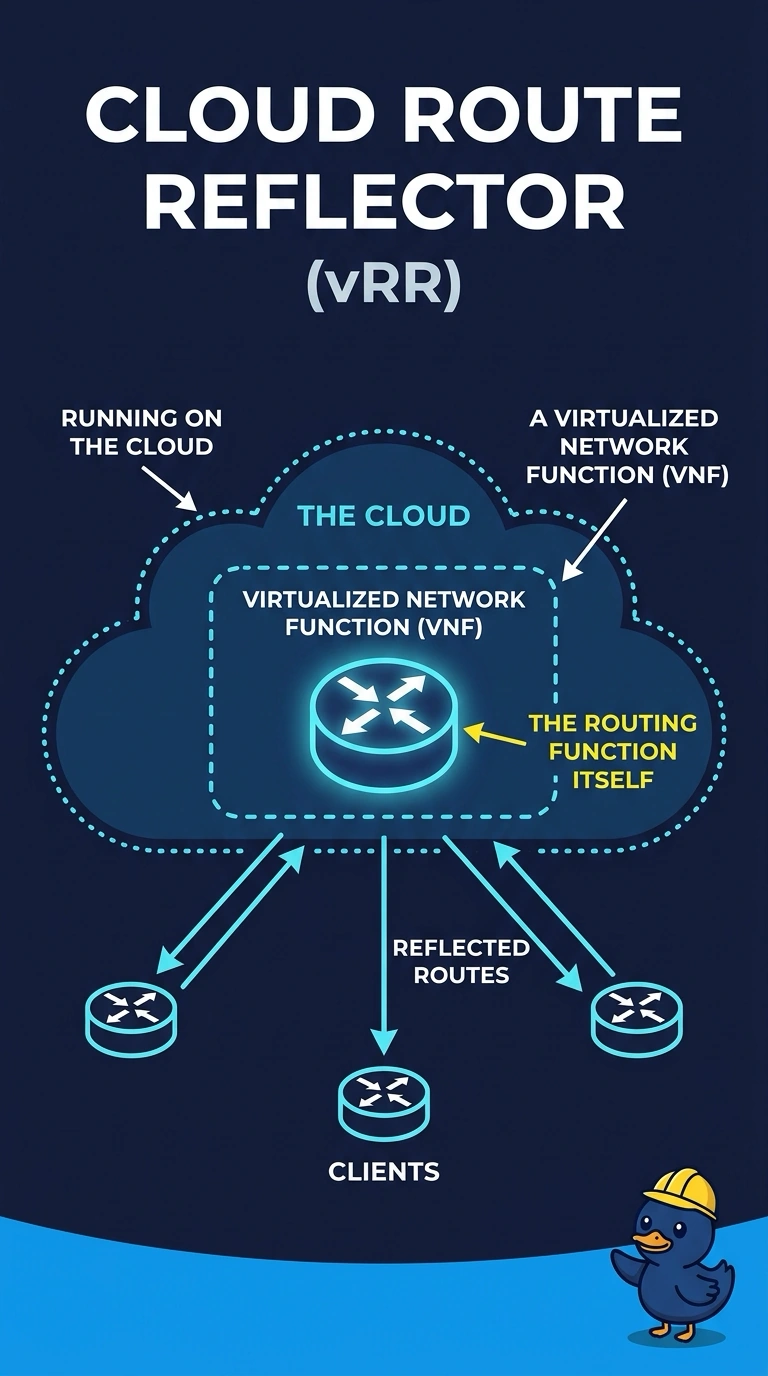
Calling the piano the conductor mixes up who plays and who cues the song. You are looking at the virtual route reflector, which is the routing function, a VNF on the cloud. The orchestration system, the NFV approach as a login box, and the VIM are different roles.
Full Explanation
NFV is the approach of running network functions on cloud compute. A VNF is one of those functions. A virtual route reflector is the routing function itself on the cloud. The orchestration system pushes service intent to devices. The VIM schedules instances, networks, and flavors. Calling the reflector the orchestration system swaps the function for the system that configures it. A virtualized network function, the routing function itself, running on the cloud is the design that meets this requirement. The orchestration system that pushes service intent to the mobile core devices is the wrong fit because The orchestration system pushes service intent, and this reflector is a routing function, not that system. The NFV approach, treated as a product the operator logs into and configures is the wrong fit because NFV is the approach of virtualizing functions, not a box you log into in place of the reflector. The infrastructure VIM that schedules instances, networks, and flavors for the cloud is the wrong fit because The VIM schedules instances and networks, and it is not the route reflector function itself. Exam caveat: NSO can configure the reflector, but that does not make the reflector the orchestrator. NFV names the approach, not a single virtual machine you log into. Operational check: In the inventory, identify the reflector as the virtual routing function and find service intent on the orchestration system, not on the VIM alone.