
Two tenants will run untrusted packet-inspection binaries on the same hosts. Each binary is one process, and a compromise must not share a kernel with the other tenant. What should host each binary?
Select an answer to reveal the explanation.
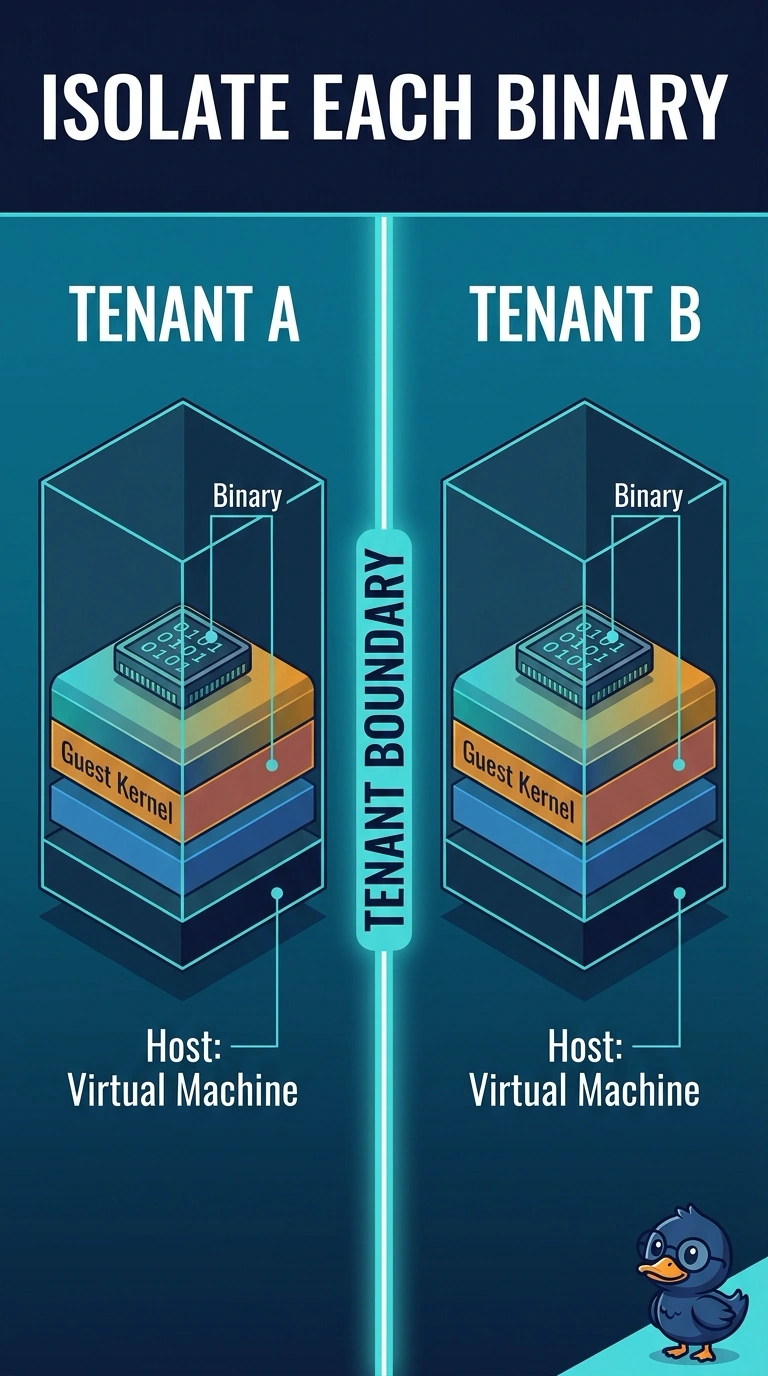
Short Explanation
Roommates who share one kitchen share one set of locks. You put each untrusted binary in a virtual machine so it has its own guest kernel. A container, a container replica set, and a process in the host namespace all stay on the shared kernel.
Full Explanation
A virtual machine carries its own guest kernel, the strong boundary between untrusted tenants. A container shares the host kernel and is what an orchestrator schedules. One process is not a reason to pick a container when a different kernel is required. A replica set of containers still shares that kernel. A process in the hypervisor namespace has no guest boundary. Each untrusted binary belongs in a virtual machine. A virtual machine with its own guest kernel and a boundary from the other tenant is the design that meets this requirement. A container that shares the host kernel with the other tenant inspection process is the wrong fit because A container shares the host kernel, so a compromise does not keep the other tenant on a different kernel. A replica set of containers scheduled together on that same shared host kernel is the wrong fit because A replica set still schedules containers on the shared kernel and does not add a guest boundary. A process started in the hypervisor host namespace beside the other tenant is the wrong fit because A process in the host namespace has no guest kernel at all and sits beside the other tenant. Exam caveat: Choose a virtual machine when the binary needs its own kernel. A container fits only a process that may share the host kernel with neighbors. Operational check: Confirm each tenant binary runs in its own guest and that a shell in one guest cannot see the other tenant kernel modules or host processes.