
Service intent is already in the orchestrator. The edge routers expose that YANG datastore only over SSH, with no HTTP configuration listener and no gRPC dial. How should the configuration be delivered?
Select an answer to reveal the explanation.
Short Explanation
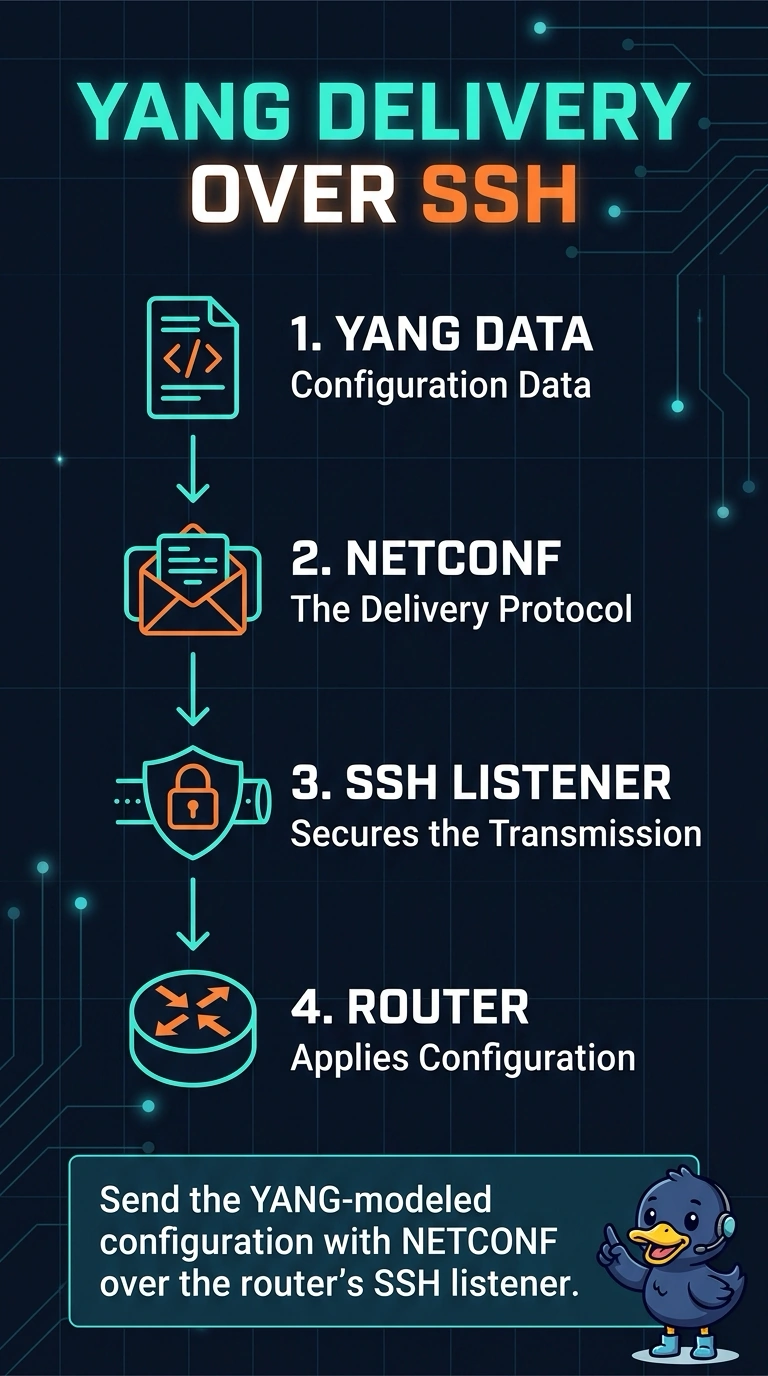
Use the door the building actually unlocks. You deliver the YANG datastore with NETCONF because these routers expose it over SSH. Generic REST, RESTCONF on a missing HTTP listener, and a VIM acting as the WAN controller do not enter that door.
Full Explanation
NETCONF edits a datastore on the router, and SSH is the listener available here. RESTCONF uses HTTPS. Generic REST is not the YANG datastore. These routers expose SSH only, with no HTTP listener and no gRPC dial. The intent already lives in the orchestrator. A VIM schedules cloud instances and is not the WAN controller. Send the YANG-modeled configuration with NETCONF over the routers’ SSH listener is the design that meets this requirement. Send a generic REST document that is not the YANG datastore on the routers is the wrong fit because Generic REST is a general API and does not carry the YANG datastore these routers expect on SSH. Use RESTCONF toward an HTTP listener that these edge routers do not expose is the wrong fit because RESTCONF carries YANG over HTTPS, and these routers have no HTTPS configuration listener to receive it. Ask the infrastructure VIM to act as the WAN controller for the edge routers is the wrong fit because the VIM schedules cloud instances and networks and is not the controller for these WAN edge routers. Exam caveat: NETCONF and RESTCONF both carry YANG, on different transports. Pick the listener the router exposes. A VIM remains a cloud controller, not the WAN service controller. Operational check: From the orchestrator, open a NETCONF session on SSH to each edge router and confirm the intended YANG configuration is committed on the device.