
A port authority's virtual firewall is dropping subscriber packets. The orchestration system that pushes service intent is idle, and its order rate is normal. Firewall resource counters confirm forwarding-capacity exhaustion, with no policy-deny, storage or link fault. A ticket says to scale the NFV by adding orchestrator capacity. What should be scaled?
Select an answer to reveal the explanation.
Short Explanation
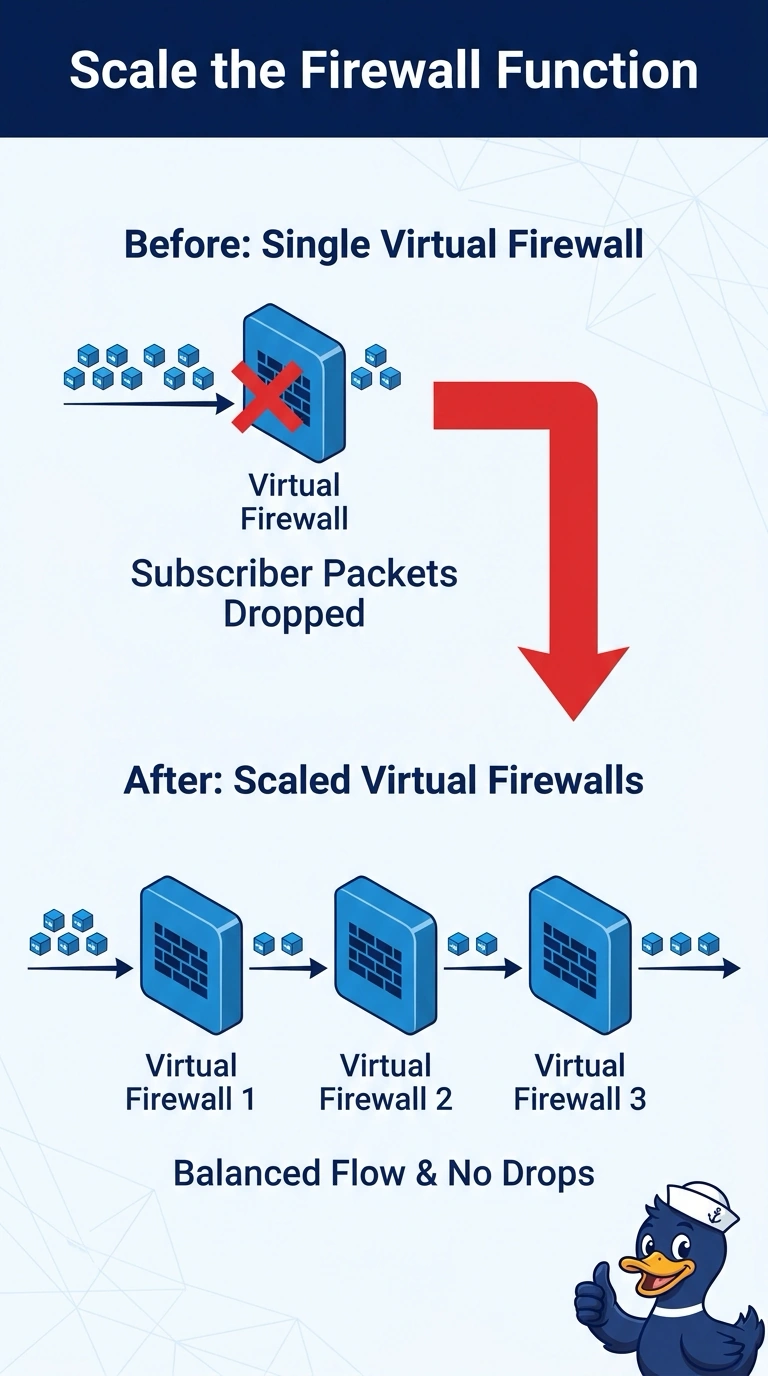
You’ve found the function actually dropping subscriber packets: the virtual firewall. The orchestrator is idle and its order rate is normal, so adding orchestrator capacity won’t restore forwarding; scale the firewall function instead.
Full Explanation
NFV implements network functions on virtualized infrastructure. The virtual firewall is the function dropping subscriber packets, and its resource counters confirm forwarding-capacity exhaustion, so scale that function. The orchestrator pushes service intent; it is idle and its order rate is normal, so adding orchestrator capacity will not add forwarding capacity. Describing the orchestrator as the system forwarding subscriber packets confuses service orchestration with the function in the packet path. A YANG module describes data; it is not the component dropping packets. A VLAN identifier budget is a segmentation limit, and the evidence does not indicate that identifiers are exhausted. The stated absence of policy-deny, storage, or link faults further supports the firewall-capacity diagnosis. Exam caveat: NFV is not a single box to scale; identify the specific network function that is constrained. Practical check: compare the firewall’s drop and resource counters with the orchestrator’s order rate, then add firewall capacity and confirm that drops fall while the orchestrator remains idle. If those checks match, you have scaled the function actually responsible for packet forwarding.