
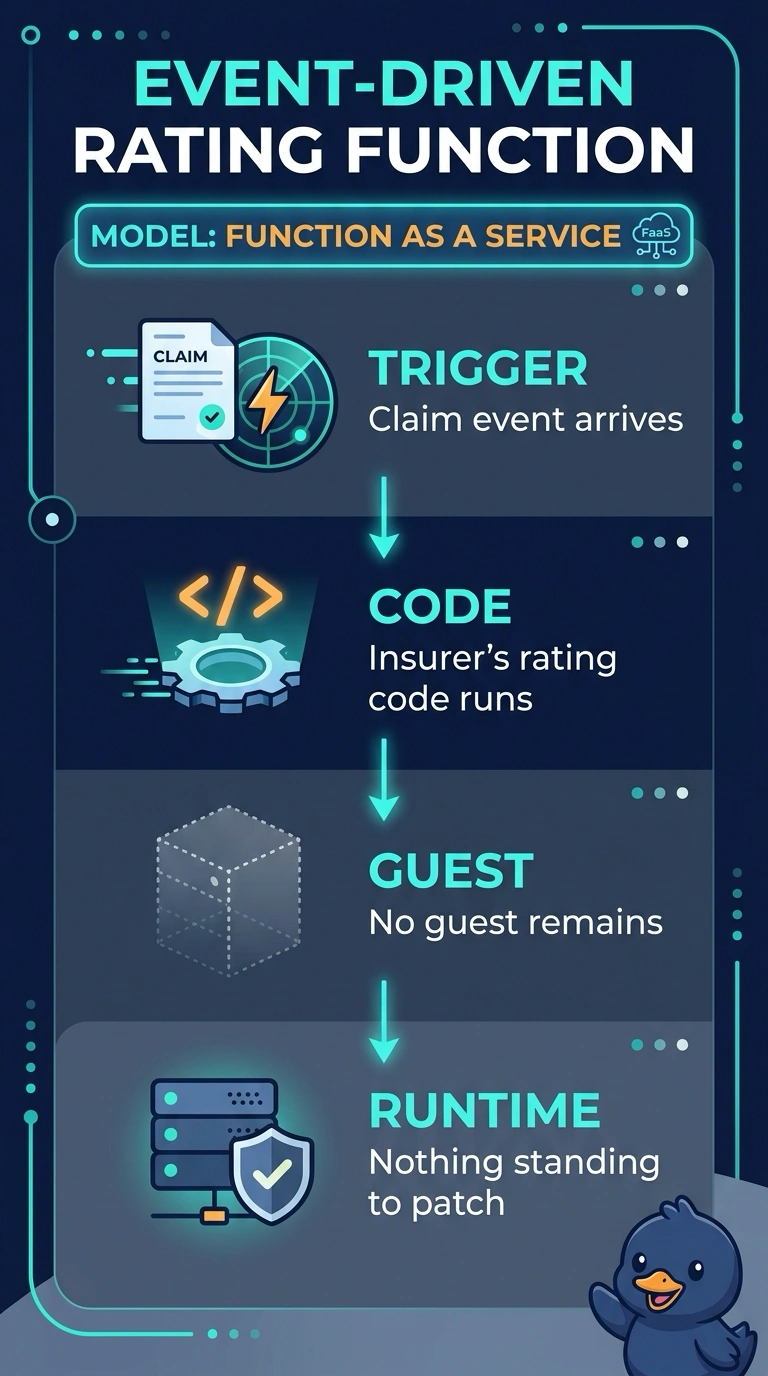
An insurer wants its own short rating function to run only when a claim event arrives, with no guest and no standing runtime left to patch. Which service model fits that function?
Select an answer to reveal the explanation.
Short Explanation
Think of the rating logic as a pop-up stall that opens for one order, not a store you keep open all week. With function as a service, you run your code when a claim event arrives, without a guest or standing runtime to patch; the other models provide a guest, a persistent runtime, or a finished vendor application.
Full Explanation
Function as a service runs the insurer’s code when a claim event arrives, without leaving a tenant guest or standing runtime to patch. Infrastructure as a service gives the insurer a guest operating system, so the insurer remains responsible for patching it. Platform as a service keeps a provider runtime available for the application between events, which does not meet the requirement to avoid a standing runtime. Software as a service supplies a finished vendor application rather than invoking the insurer’s own rating function. Function as a service, invoking the insurer’s code on the event and leaving no guest, is therefore the model that fits. Exam caveat: “no standing runtime” means no tenant-managed runtime that must remain available between events; the provider still operates the underlying service infrastructure. Practical check: confirm that the claim event invokes the rating logic and that no tenant guest or standing runtime remains to patch.