
An insurer’s OpenStack claims VM boots from a Nova-provisioned ephemeral root disk, not a Cinder volume. The guest writes claim files only to that disk. The instance is deleted and a new one is booted from the same image. The files are gone. Which constraint explains that loss?
Select an answer to reveal the explanation.
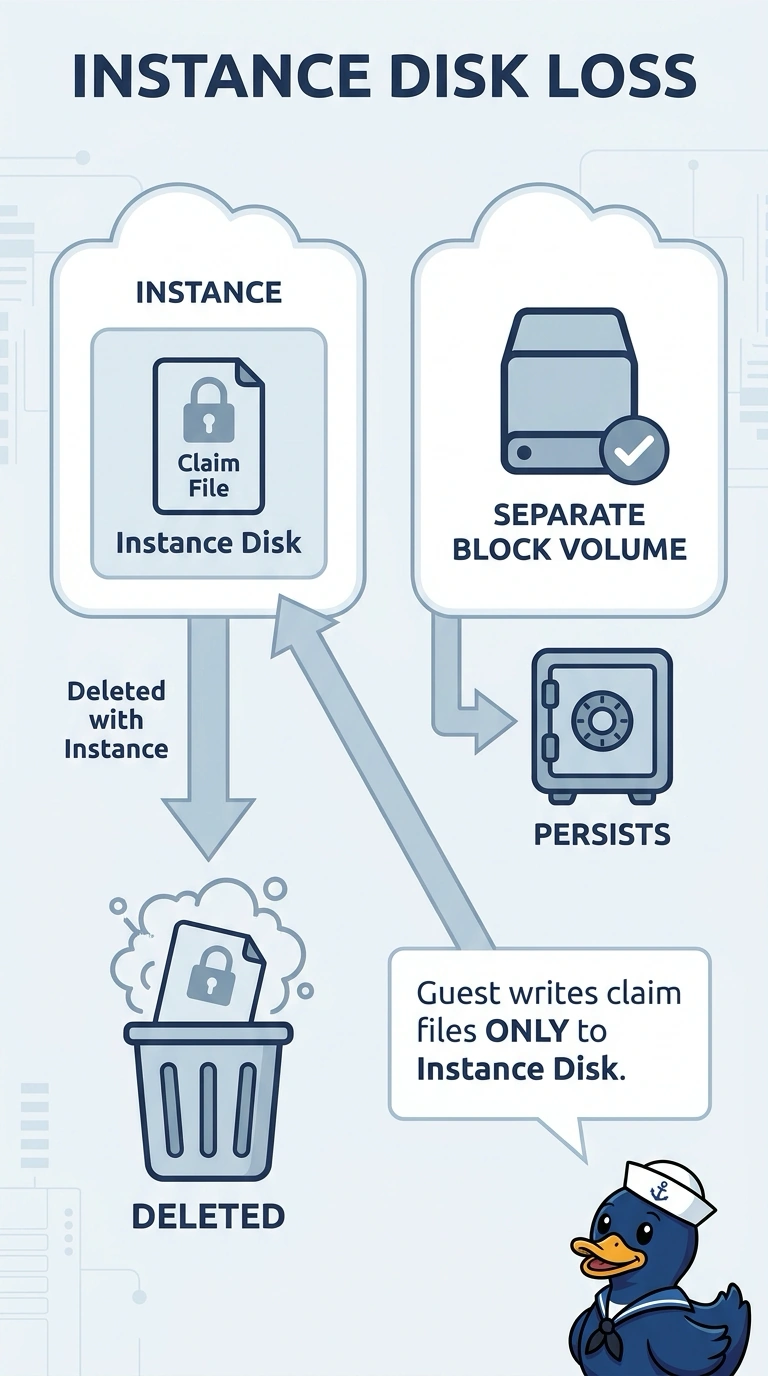
Short Explanation
Notes written on a hotel whiteboard are gone when you check out, even if you book the same room type tomorrow. Those claim files lived on the disk that was created with the instance, and that disk left with the instance. You need separately retained storage if those files must survive instance deletion.
Full Explanation
The specified Nova-provisioned ephemeral root disk exists only for this instance’s lifetime and is removed when the instance is deleted. A separately retained Cinder volume can survive instance deletion when its delete-on-termination setting is disabled. That is the constraint that explains the missing files. VLAN identifier exhaustion is a segmentation limit and does not wipe files that were written and then lost on delete. Sharing the host kernel is a container property, and it does not describe a guest whose files were present until the instance was deleted. The orchestration system pushing a router configuration is a service-intent action, and nothing here says the files were overwritten by a router config; they disappeared with the instance. Exam caveat: some platforms can flag an attached volume to be deleted with the instance, so a volume is safe only when that flag is off. Operational check: Attach a Cinder volume, verify delete-on-termination is disabled, write a test file, then delete and replace the VM and confirm the retained volume still contains the file.