
A cable operator wants one system to push service intent for a virtual router service across the devices that implement it. Which component does that orchestration?
Select an answer to reveal the explanation.
Short Explanation
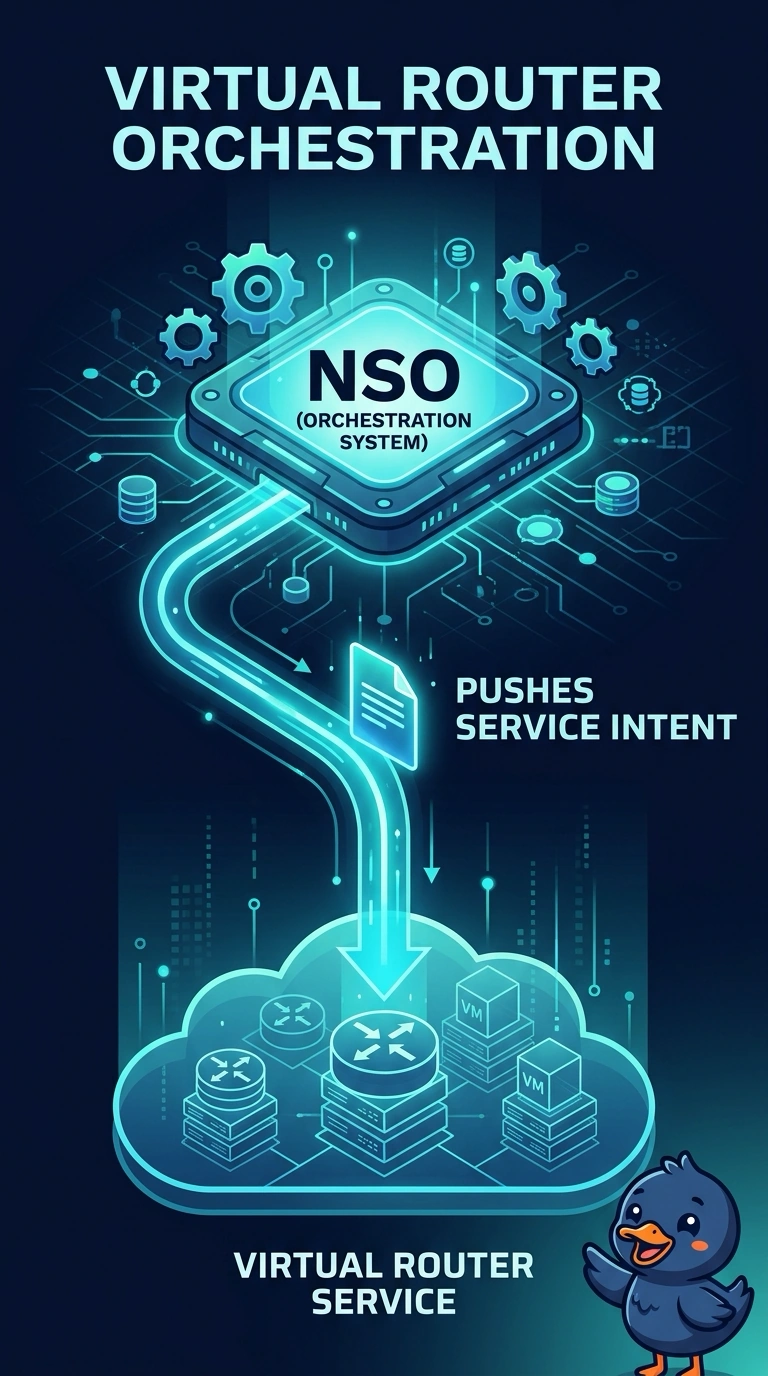
The conductor with the score is not the musician and not the name of the art form. You use NSO to push service intent for the virtual router service across the devices that build it. The VNF itself, the NFV approach, and the virtual router image are the workload, the program, and the platform.
Full Explanation
NSO is the orchestration system that pushes service intent and configuration across the devices in a service. The VNF is the virtualized function being orchestrated, not the orchestrator. NFV is the approach of virtualizing network functions, not a product that logs in. The virtual router image is the platform function running on the cloud. The cable operator asked for the system that pushes intent, which is NSO. NSO as the orchestration system that pushes service intent for the virtual router service is the design that meets this requirement. The VNF itself, asked to act as the orchestrator for every other device in the service is the wrong fit because the VNF is the function being configured, and asking it to push intent makes the workload act as the orchestrator. The NFV approach, treated as a product that logs in and configures the service devices is the wrong fit because NFV names the approach of virtualizing functions, and the name is not a system that logs in and pushes intent. The virtual router image, used as the orchestrator instead of as the platform function is the wrong fit because the image is the platform function that runs as the virtual router, and it is not the system that pushes intent. Exam caveat: NSO is the system that pushes service intent across devices. It is not the VNF, not the NFV approach, and not the virtual router image that runs as the platform function. Operational check: In the orchestration record, confirm NSO is the system pushing the virtual router service intent and that the image is the function being configured.