
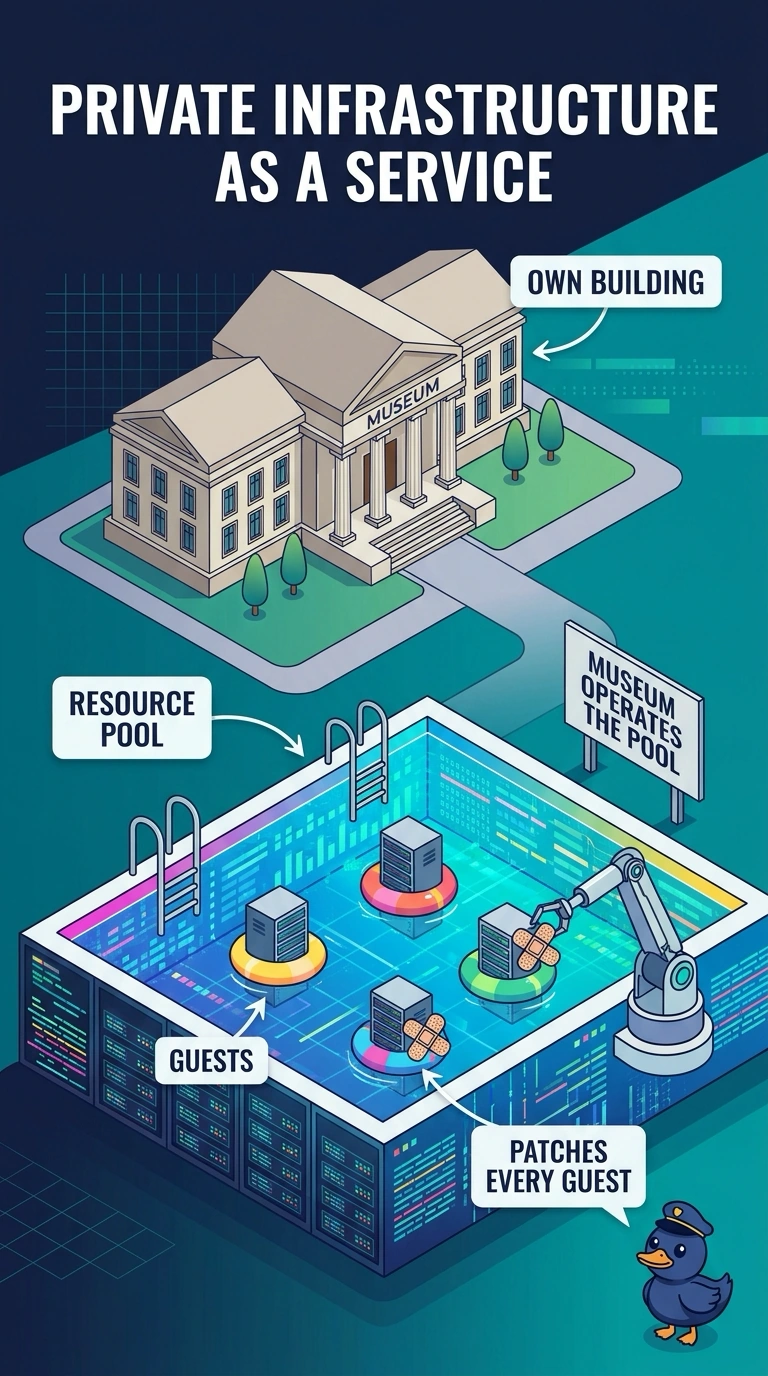
A museum operates the compute pool in its own building, patches every guest itself, and does not burst onto a provider-operated pool. Which cloud model is this?
Select an answer to reveal the explanation.
Short Explanation
Owning the workshop and maintaining the tools is different from renting a bench in someone else's shop. You are looking at private infrastructure as a service because the museum operates the pool and patches the guests. Public infrastructure as a service, hybrid infrastructure as a service, and platform as a service change the operator, add a burst, or hide the guest.
Full Explanation
Infrastructure as a service hands the tenant the guest to patch, so the service model stays the same across deployments. The museum operates the pool in its own building, patches every guest, and does not burst onto a provider pool, so the model is private infrastructure as a service. A private cloud is provisioned for exclusive use by an organization and can be operated by that organization or a third party. A hybrid cloud combines distinct, connected clouds; bursting is one example. Private infrastructure as a service, with the museum operating the pool and patching the guests is the design that meets this requirement. Public infrastructure as a service, with a provider operating the pool the museum already runs in that other design is the wrong fit because it is provisioned for open use, not exclusive museum use. Hybrid infrastructure as a service that needs a burst pool the museum does not use is the wrong fit because there is only one cloud here, not two distinct connected clouds. Platform as a service that would hide the guest and hand the museum only a runtime is the wrong fit because it would remove guest patching, which the museum still does.