
A research campus has assigned every usable 802.1Q identifier from 1 through 4094. A new lab still needs one isolated Layer 2 segment so two appliances can exchange broadcasts. What should carry it?
Select an answer to reveal the explanation.
Short Explanation
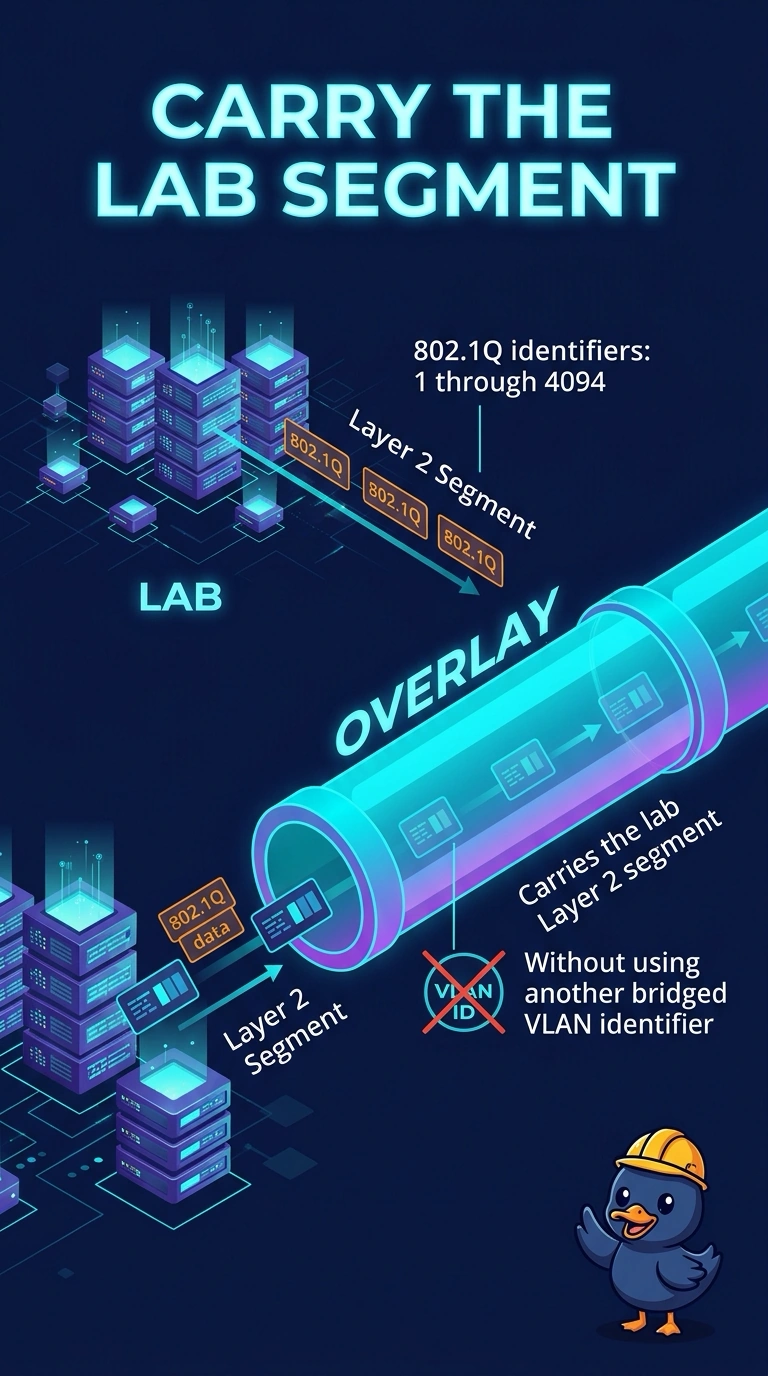
A full coat rack cannot take another hanger, so the next coat needs a different rail. You carry the lab broadcasts in an overlay because every identifier from 1 through 4094 is already assigned. A routed network, reuse of another lab VLAN, and an identifier outside 1 through 4094 miss the broadcasts or the identifier rules.
Full Explanation
The campus has already assigned every usable bridged identifier from 1 through 4094, so another VLAN on that bridge is not available. The new lab still needs broadcasts between two appliances, which a routed network would remove. An overlay can carry that Layer 2 segment without consuming another bridged identifier. Reusing some other lab VLAN merges the labs. An identifier outside 1 through 4094 is not a usable additional VLAN. An overlay that carries the lab Layer 2 segment without using another bridged VLAN identifier is the design that meets this requirement. A routed network that removes the broadcasts the two lab appliances still need to exchange is the wrong fit because a routed network isolates at layer 3 and drops the broadcasts these two appliances still need to exchange. Reuse of a VLAN that another lab already owns, so the two broadcast domains merge is the wrong fit because reusing another lab VLAN merges the broadcast domains and does not isolate the new lab at all. A bridged identifier outside 1 through 4094 on the same switched campus network is the wrong fit because usable 802.1Q identifiers are only 1 through 4094, so an identifier outside that range is not a new bridged segment. Exam caveat: If the lab did not need broadcasts, a routed network could isolate it without an overlay. The appliances here still need the Layer 2 segment. Operational check: Confirm no free identifier from 1 through 4094 remains, confirm the two appliances still exchange broadcasts on the overlay, and confirm they are not bridged into another lab VLAN.