
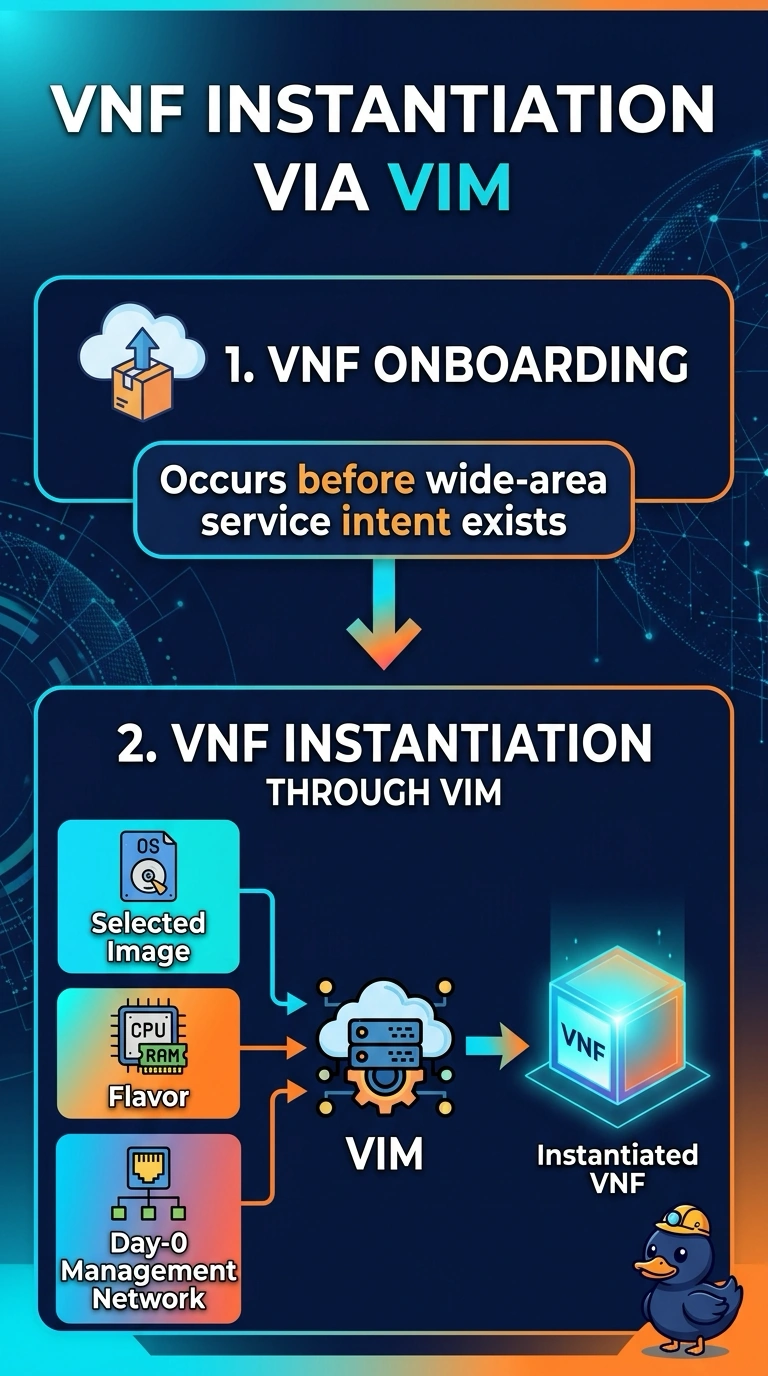
A mobile-core team must create a virtual router instance, choose its flavor, and attach day-0 networks before any wide-area service intent exists. Which system performs that instantiation?
Select an answer to reveal the explanation.
Short Explanation
Stocking a kitchen and hooking up the gas is not writing the menu for the whole city. You instantiate the virtual router in the VIM with the image, flavor, and day-0 management network. Wide-area service intent, a YANG session to an existing router, and a telemetry stream do not create that running instance.
Full Explanation
Onboarding prepares the artifacts and deployment model; instantiation creates the running instance. Instantiate the VNF through the VIM using the selected image, flavor, and day-0 management network to bring up the running virtual router before any wide-area service intent exists. OpenStack is one such manager for instances, networks, and flavors, not a wide-area controller. NSO service intent pushed across wide-area devices after the instance already exists is the wrong fit because NSO pushes service intent across devices after the virtual router has been instantiated. A NETCONF or RESTCONF session that carries YANG to a router already present in the network in that other design is the wrong fit because NETCONF and RESTCONF carry YANG to a device that already exists and do not create the flavor or running instance. A gNMI client that streams telemetry from devices and does not create the cloud instance is the wrong fit because gNMI over gRPC handles telemetry and configuration, not VIM instantiation. Exam caveat: OpenStack is one infrastructure manager for instances, networks, and flavors, not a wide-area controller. Operational check: Confirm the instance, flavor, and day-0 networks exist in the infrastructure manager before any NSO service intent is pushed.