
A rail laboratory must run a vendor track probe that ships with its own kernel and must keep its own guest kernel separate from other workloads under a trusted hypervisor. Which placement meets that requirement?
Select an answer to reveal the explanation.
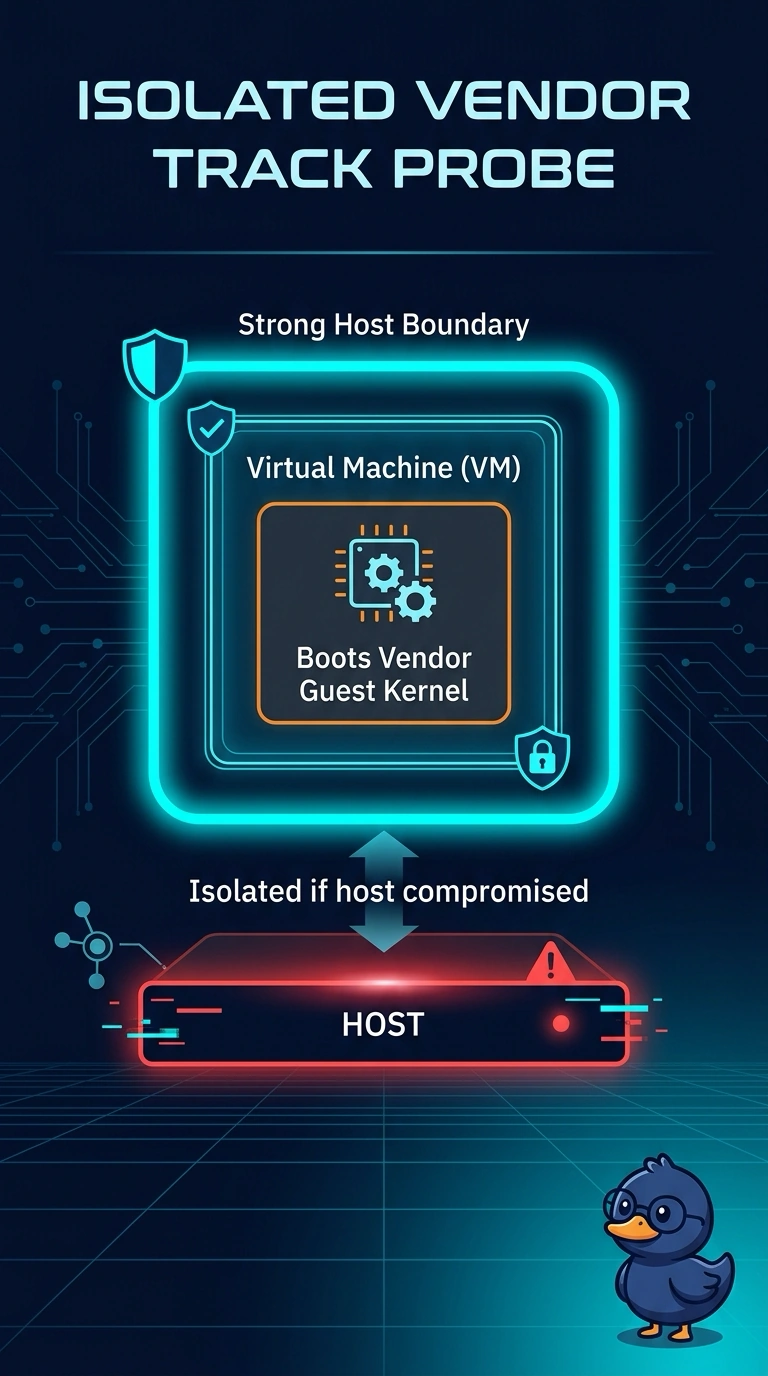
Short Explanation
You need a virtual machine because it boots the vendor’s guest kernel and keeps it separate from other workloads through the hypervisor. A process-level container, a privileged container, and a host process still use the host kernel, so none meets that need; remember that a compromised host or hypervisor can undermine the VM’s boundary.
Full Explanation
A virtual machine carries its own guest operating system, so the probe can boot the kernel shipped by the vendor and keep that guest kernel separate from other workloads under a trusted hypervisor. This meets the requirement for a separate guest kernel and a strong boundary from the host, although a compromised host or hypervisor can undermine that boundary. A container scheduled as a process-level unit shares the compute host kernel with other pods, so it cannot boot the vendor’s kernel; containers fit workloads built to run as processes on the host kernel. A privileged container can mount host devices, but it still runs on the same host kernel, so privileged access does not create a separate guest kernel or the required guest boundary. A host process started by the node agent has no separate guest kernel and no guest boundary, so it cannot provide the required separation. Exam caveat: namespaces and a read-only root may limit access, but they still share the host kernel and do not satisfy a requirement to boot a vendor-provided kernel. Practical check: confirm that the workload is a virtual machine and that it boots the vendor guest kernel.