
A virtual firewall is already running on the cloud. The provider wants one system to push the same service intent to that firewall and to the physical edges. Which system has that role?
Select an answer to reveal the explanation.
Short Explanation
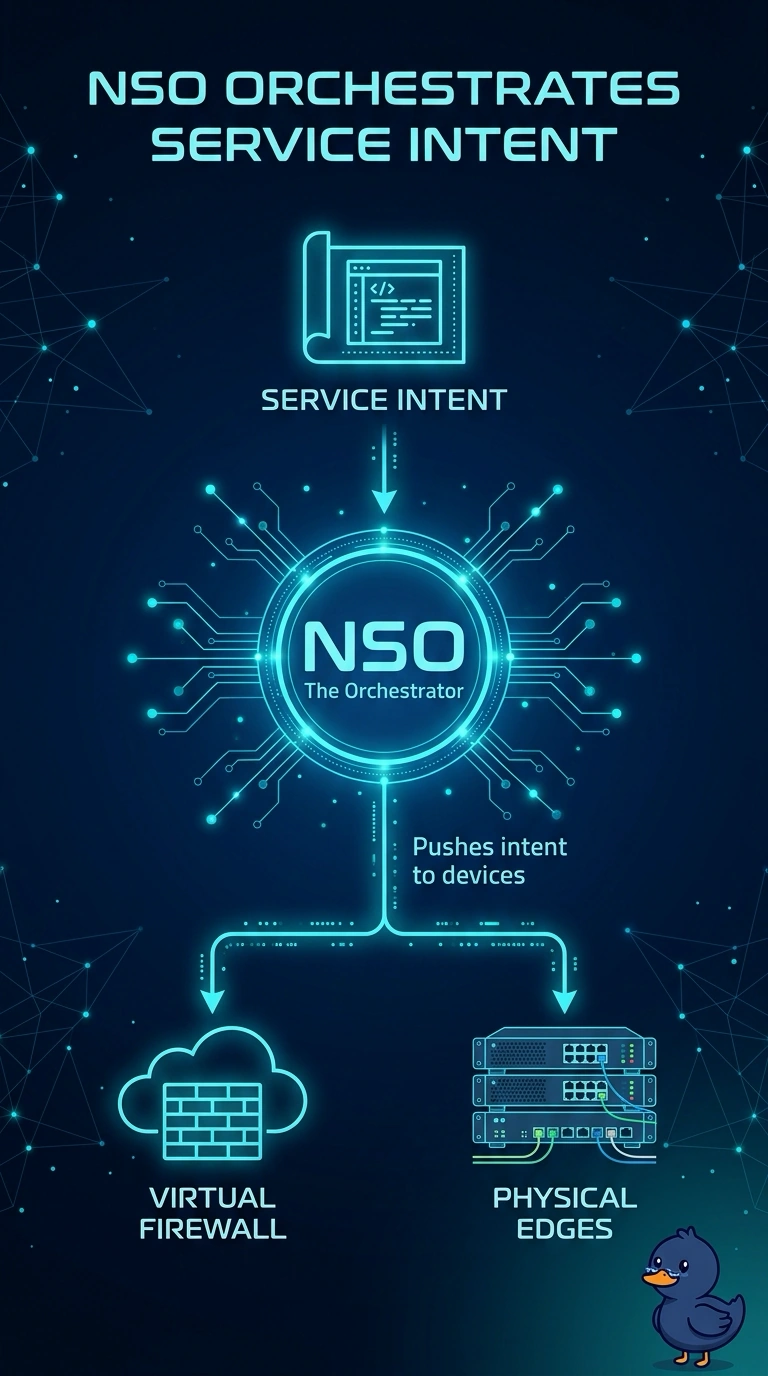
The musician plays, and someone else writes the set list for the whole band. You use the orchestrator to push the same service intent to the virtual firewall and the physical edges. The firewall platform, the NFV approach, or a virtual router image does not push that intent.
Full Explanation
NSO is the orchestration system that pushes service intent to the virtual firewall and the physical edges. The firewall is the function that filters packets, not the system that orchestrates the service. NFV names the approach and is not a box that pushes configuration. A virtual router image is another platform, and the image is not the orchestrator. Keep the function, the approach, and the intent system apart. NSO as the orchestrator that pushes the service intent to those devices is the design that meets this requirement. The virtual firewall platform that filters packets and does not orchestrate the service is the wrong fit because the firewall platform is the VNF that filters packets, and it does not push intent to the edges. The NFV approach as a method rather than a system that pushes service intent is the wrong fit because NFV is the approach of virtualizing functions, and the approach itself is not the orchestrator. A virtual router image that is another function and not the service orchestrator is the wrong fit because a virtual router image is a different platform, and that image does not push service intent. Exam caveat: NSO pushing intent is not the same step as onboarding the firewall image. The guest has to exist before service intent has a virtual firewall to configure. Operational check: Push a lab service change from NSO, confirm the same intent lands on the virtual firewall and on a physical edge, and confirm the firewall image was not used as the orchestrator.