
A hosting provider has already assigned every usable bridged identifier from 1 through 4094 on one domain and still needs more isolated tenants. How should new tenant segmentation be built?
Select an answer to reveal the explanation.
Short Explanation
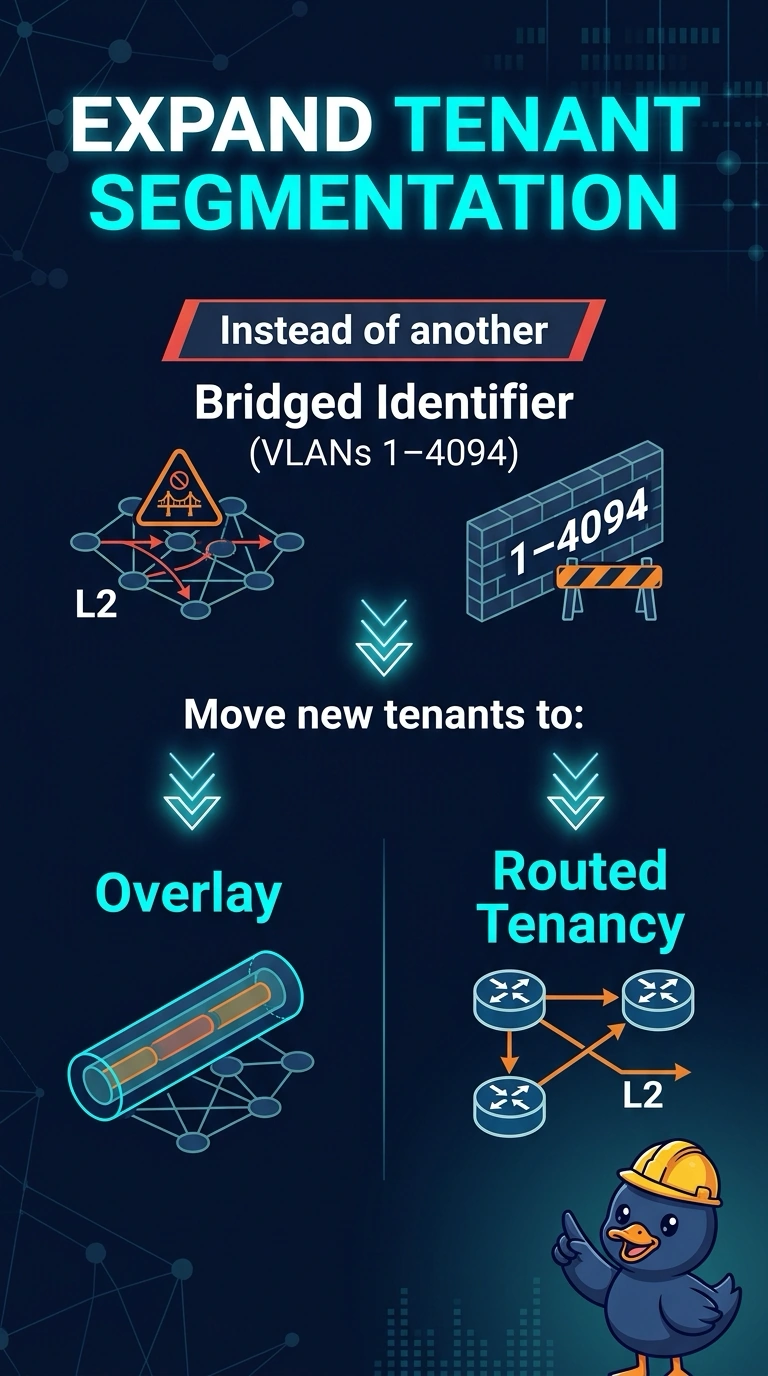
You can think of a bridged domain as a garage with every numbered stall taken: there is no new number to paint on the same ramp. Once identifiers 1 through 4094 are used, move new tenants to an overlay or routed tenancy for isolation. Reusing an assigned identifier, stretching the same flat bridged domain, or expecting an identifier beyond that range will not add isolation.
Full Explanation
One bridged domain has 4094 usable 802.1Q identifiers, numbered 1 through 4094. When that budget is spent, you cannot create more isolated tenants by stretching the same bridge or reusing an identifier. Move new tenants to an overlay or routed tenancy so isolation no longer depends on adding another bridged identifier on that domain. Reusing an identifier already assigned on the bridged domain puts a new tenant in a broadcast domain that belongs to someone else, so it does not provide the required isolation. Stretching the same flat bridged domain onto more switches extends that bridge but leaves the identifier space unchanged and does not isolate another tenant. Expecting the domain to accept identifiers beyond 1 through 4094 fails because the usable 802.1Q identifier space on one bridged domain stops at 4094; a higher identifier is not available there. Exam caveat: The 4094 figure describes the usable 802.1Q identifier space on a bridged domain, not a platform quota that can be raised by changing a vendor license. Operational check: Confirm that every identifier from 1 through 4094 is consumed on the bridge, then place the next tenant in an overlay or a routed virtual network.