
An infrastructure cloud bridges every tenant network on one Layer 2 domain and has used all 4094 usable 802.1Q identifiers. New tenants still need isolation from one another. Which design removes that constraint?
Select an answer to reveal the explanation.
Short Explanation
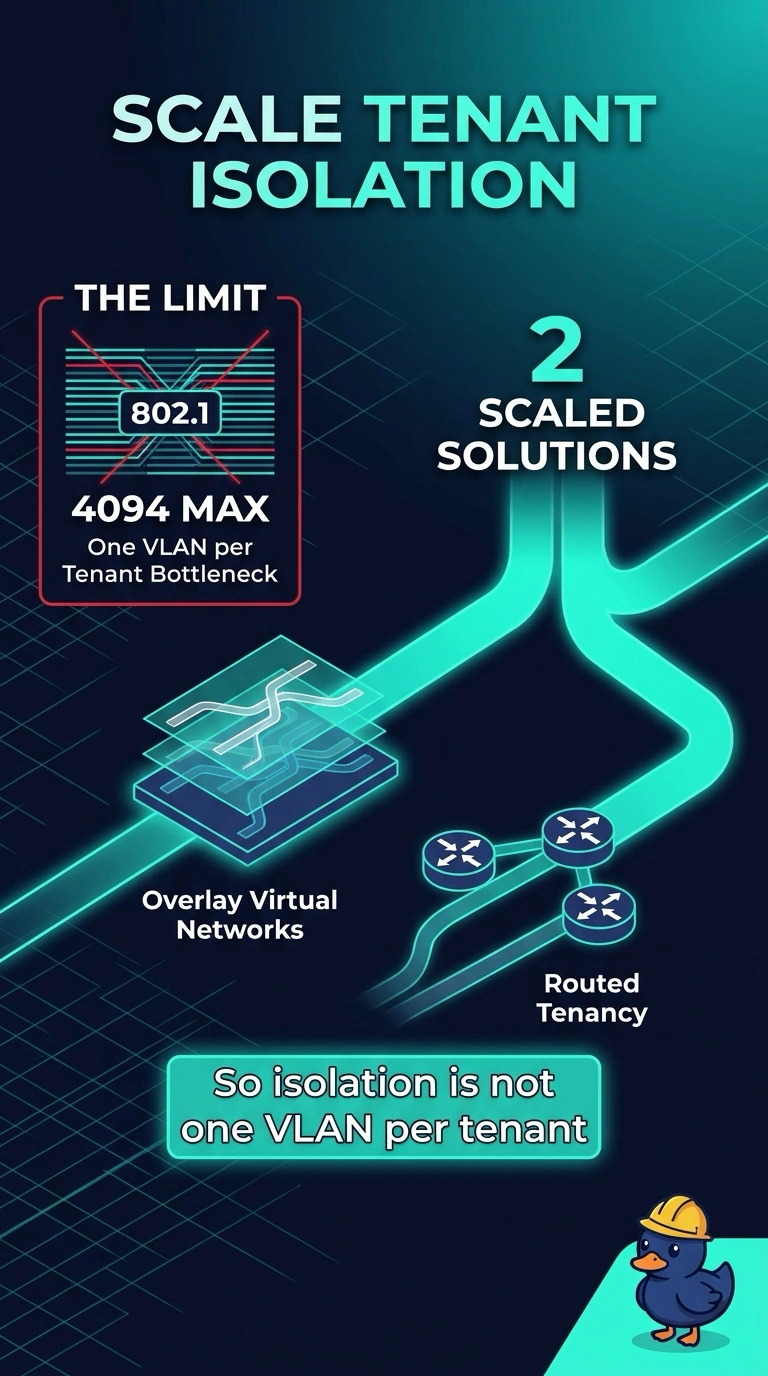
A parking garage with a fixed number of stalls cannot invent new stall numbers. You move new tenants to overlay virtual networks or to routed tenancy once all 4094 usable identifiers are taken. One flat VLAN, a reused identifier on the same bridge, or a longer identifier field does not create more isolation on that bridge.
Full Explanation
One bridged domain has 4094 usable 802.1Q identifiers, numbered 1 through 4094. When that budget is spent, another tenant cannot get its own VLAN on the same bridge. Isolation has to move to an overlay virtual network or to routed tenancy, where the VLAN identifier is no longer the tenant boundary. A shared flat VLAN and a reused identifier both fail isolation. The identifier field itself does not expand. Overlay virtual networks or routed tenancy so isolation is not one VLAN per tenant is the design that meets this requirement. One flat VLAN stretched across every new tenant on that same bridged domain is the wrong fit because one flat VLAN puts the new tenants in the same broadcast domain and does not isolate them from each other. Reuse of a VLAN identifier that is already active on that same bridged domain is the wrong fit because reusing an active identifier on the same bridge merges two tenants instead of isolating them. An extension of the 802.1Q identifier so one bridge holds more than 4094 tenants is the wrong fit because the 802.1Q identifier field does not grow past the 4094 usable values on that bridged domain. Exam caveat: An overlay uses a separate segment identifier while 802.1Q still has the same VLAN ID field. Overlays can also be useful with spare VLANs when tenants need independent tag spaces. Operational check: Count identifiers on the bridged domain, confirm 1 through 4094 are consumed, and confirm a new tenant attaches by an overlay or a routed hop rather than a new VLAN.