
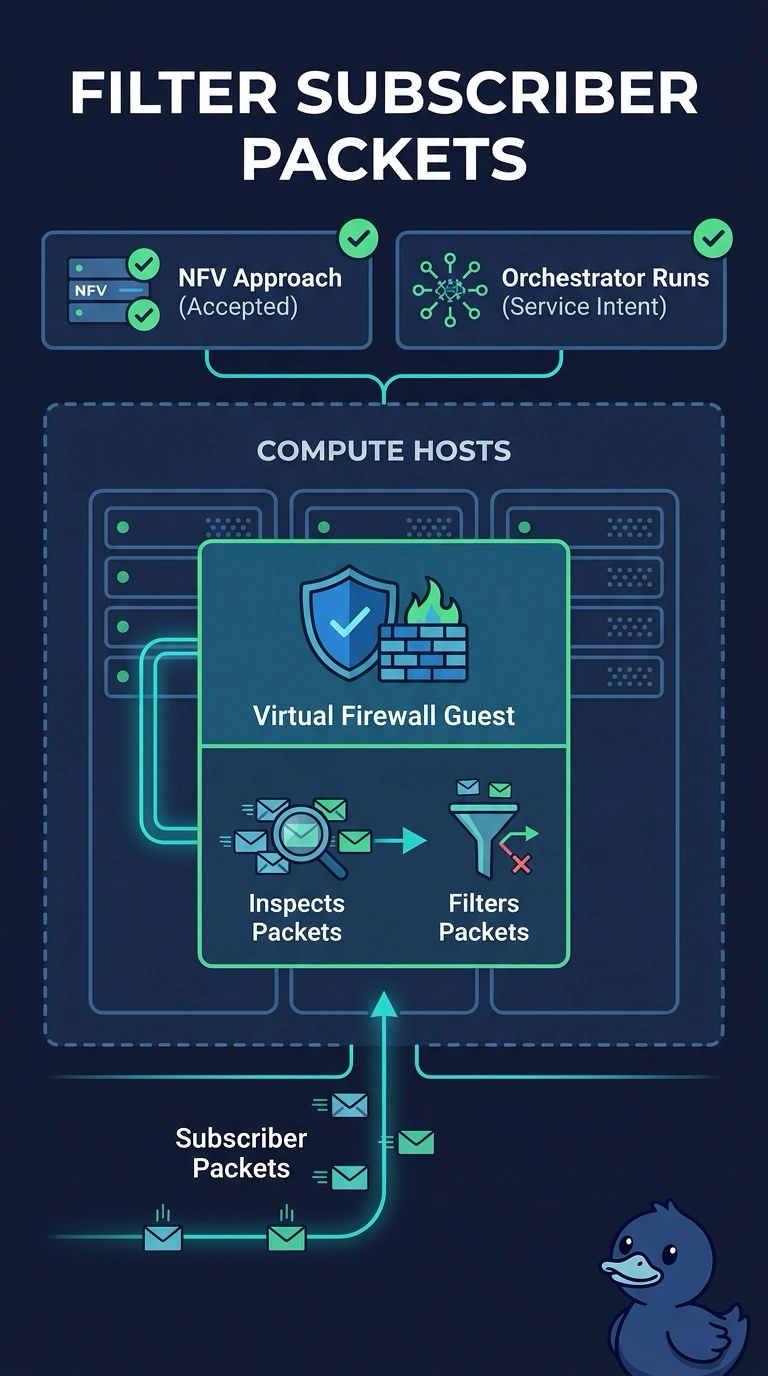
A mobile carrier already accepted the NFV approach and already runs an orchestrator for service intent. Subscriber flows still need a guest that inspects and filters packets. What should be placed on the compute hosts?
Select an answer to reveal the explanation.
Short Explanation
A recipe card is not dinner, and the person who orders dinner is not the cook. You still need a virtual firewall guest on compute to inspect subscriber packets. An architecture paper, a service orchestrator, or a stored YANG model does not sit on that path.
Full Explanation
NFV is the method of moving network functions onto cloud compute, and the method itself does not sit on the packet path. The guest that filters subscriber traffic is the virtual firewall platform, which is the VNF. An orchestrator can activate that service, and a YANG model can describe the intent, but neither one inspects packets. The carrier still has to place the firewall platform on compute so subscriber flows are examined there. A virtual firewall guest that inspects subscriber packets on the compute hosts is the design that meets this requirement. An NFV architecture paper that names the approach but forwards no packets is the wrong fit because the paper only names the NFV approach and does not itself inspect or forward a subscriber flow. A service orchestrator that pushes intent but does not inspect user packets is the wrong fit because service intent tells the inventory what should exist and does not examine subscriber packets. A YANG service model stored on the controller with no forwarding guest is the wrong fit because a YANG model can describe the service and is not the guest that filters subscriber traffic. Exam caveat: NFV, the virtual firewall, and the orchestrator are three roles. Naming the project NFV does not tell you which function was placed on compute. Operational check: Send a subscriber flow that should be denied, confirm the deny is logged on the virtual firewall guest, and confirm the orchestrator shows no per-packet counter for that flow.