
Bridged tenant isolation has consumed every usable 802.1Q VLAN identifier, the 4094 values from 1 through 4094. New tenants still need isolation. Which design removes that limit?
Select an answer to reveal the explanation.
Short Explanation
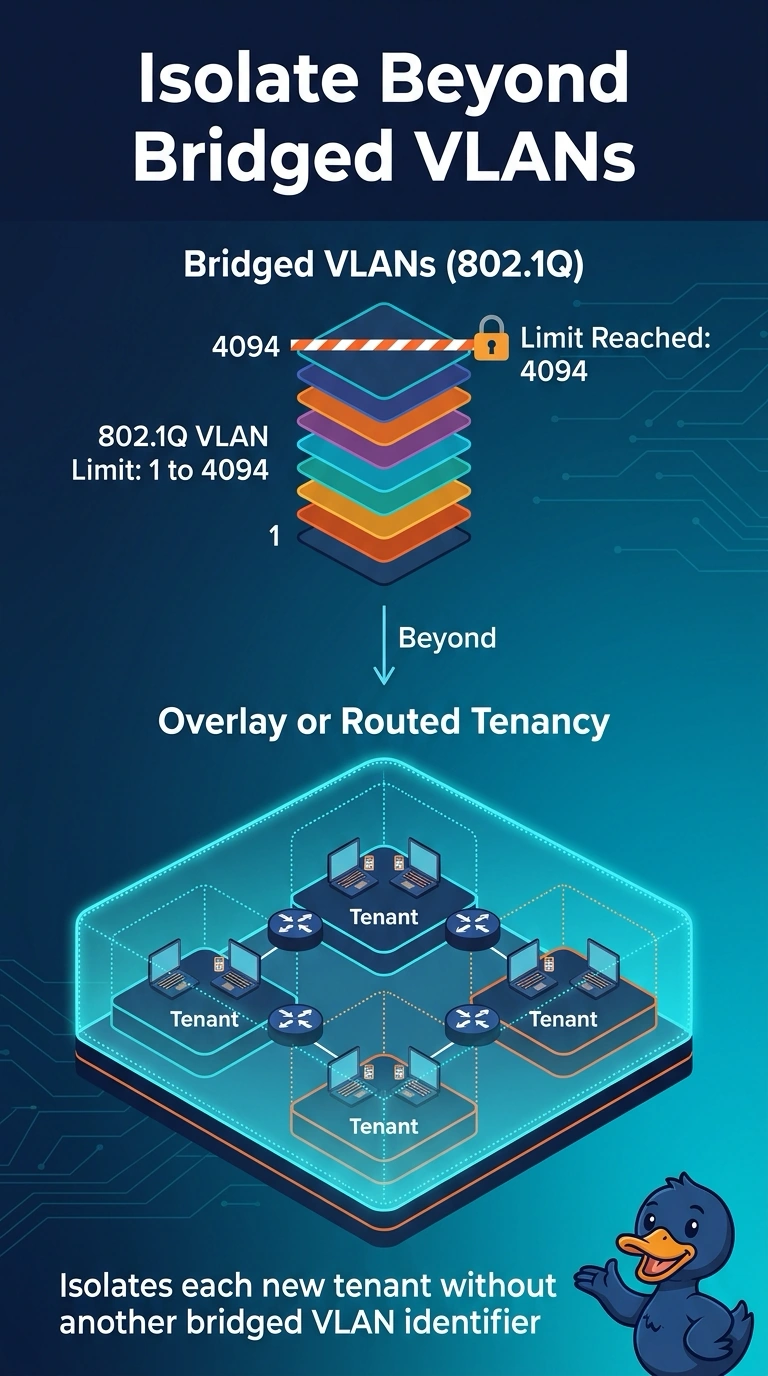
Running out of apartment numbers means you need a new way to label homes, not a copy of a key that already failed. You move to an overlay or to routed tenancy once all 4094 bridged VLAN identifiers are in use. Extra bridged VLAN numbers, one flat VLAN for every tenant, and IPsec on the same VLANs do not add isolation.
Full Explanation
An 802.1Q VLAN identifier is a 12-bit field. The usable values on one bridged domain are 1 through 4094, so there are 4094 identifiers. Once they are consumed, another bridged VLAN on that domain cannot separate the next tenant. Isolation moves to an overlay or to routed tenancy. A shared flat VLAN removes isolation, and IPsec does not add identifiers. An overlay or routed tenancy that isolates each new tenant without another bridged VLAN identifier is the design that meets this requirement. Additional bridged VLAN identifiers on the same domain past the 4094 usable 802.1Q values is the wrong fit because it assumes the bridged identifier space can grow past the 4094 usable values, and that space is exhausted. One flat VLAN shared by every new tenant as a single broadcast domain across the cloud is the wrong fit because it places every new tenant in one broadcast domain and does not isolate those tenants from each other. IPsec on the existing tenant VLANs to hide payloads while keeping those same bridged segments is the wrong fit because it encrypts payloads on VLAN segments that already exist and does not create a new isolation boundary. Exam caveat: Do not invent a larger bridged VLAN space than the 4094 usable 802.1Q identifiers. Overlay and routed tenancy are valid escapes. Encryption of the old VLANs is not one of them. Operational check: Confirm bridged VLAN use has reached the 4094 usable identifiers and that each new tenant is placed in an overlay or a routed virtual network.