
A tenant must patch its own guest operating system while the provider operates the compute pool under that guest. Which cloud service model fits?
Select an answer to reveal the explanation.
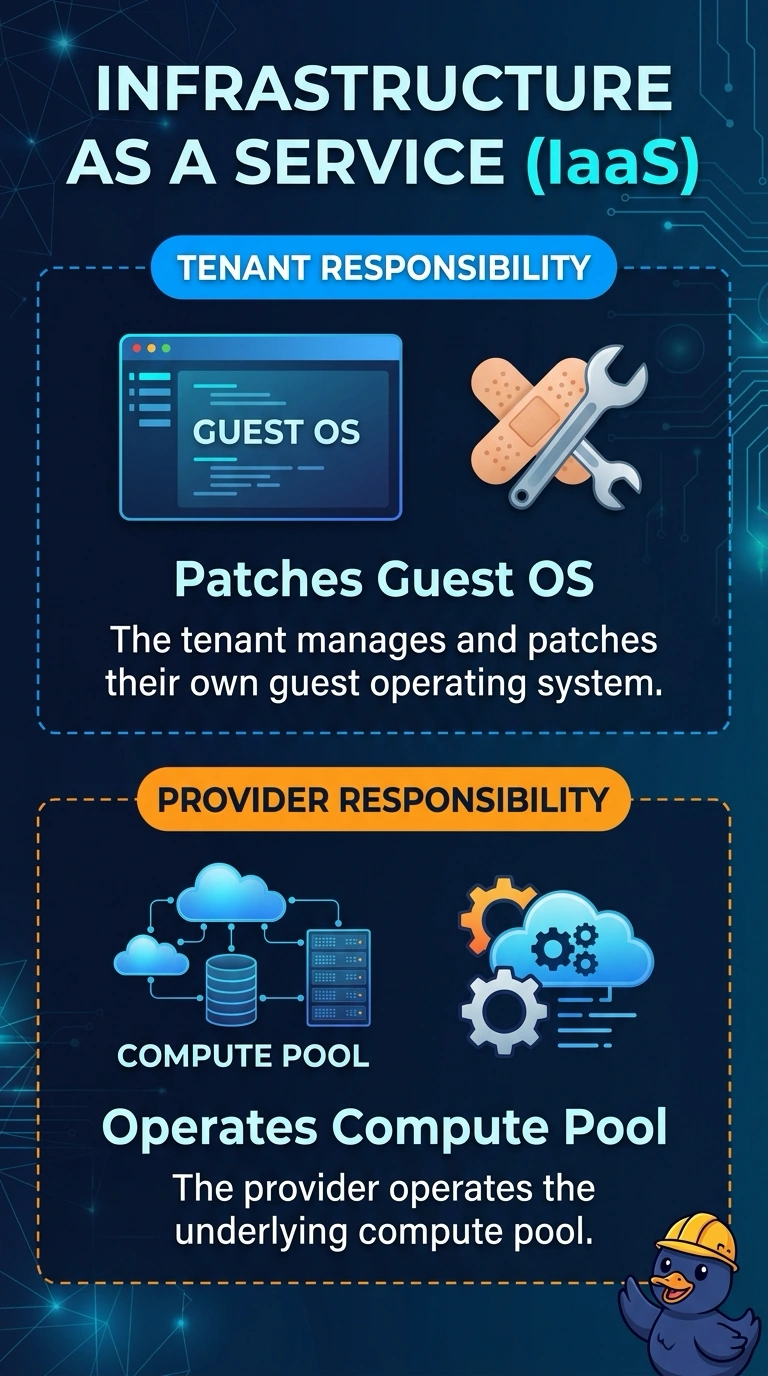
Short Explanation
Think of it like having your own apartment to maintain while the building operator manages the shared infrastructure. You need infrastructure as a service because you patch the guest operating system while the provider operates the compute pool. With platform as a service, software as a service, or functions as a service, the provider keeps the guest or there is no guest for you to patch.
Full Explanation
Infrastructure as a service fits because you patch the guest operating system while the provider operates the compute pool beneath it. Platform as a service, with the tenant receiving a runtime and the provider keeping the guest, does not fit: the provider retains the guest, so the tenant is not responsible for patching it. Software as a service, with the tenant receiving the application and no guest operating system, does not fit because the tenant has no guest to patch. Functions as a service, with event-driven code and no guest operating system left to patch, also does not fit because there is no guest for the tenant to maintain. The key distinction is the responsibility boundary: a service model identifies which layer the provider manages and which layer remains the tenant’s responsibility. An exam caveat is that a tenant’s responsibility for guest patching does not mean the tenant operates the underlying compute pool; the provider still operates that pool in the stated arrangement. As a practical check, confirm that the tenant can patch its own guest operating system and that the provider operates the compute pool under that guest instance.